
WebOps vs DevOps: Fundamental Differences and When to Use Each
Modern digital teams are under constant pressure to move faster. As organizations scale, two operating models often surface in this conversation: DevOps and WebOps.
While they share common DNA – automation, collaboration and continuous improvement – they solve very different problems. That’s why, in this post, we’ll break down WebOps vs DevOps. We’ll cover what each model is designed to optimize, what they serve and when each approach makes the most sense.
What is DevOps?
DevOps (development + operations) is a modern approach to software development and IT operations that brings together people, processes and tools to deliver software faster and more reliably. Its core goal is to break down silos between teams and create a unified process for building, testing, deploying and maintaining software.
DevOps spans the full software development lifecycle: planning, coding, testing, releasing, deploying, operating and monitoring. Modern DevOps practices emphasize:
- Continuous integration/continuous deployment (CI/CD) automation to ship updates safely and continuously.
- Infrastructure as Code (IaC) to configure servers and cloud environments programmatically.
- Containers and orchestration (Docker, Kubernetes) for consistent, scalable deployments.
- Observability – logs, metrics and traces – to understand system health.
- DevSecOps to integrate security checks throughout the pipeline rather than at the end.
DevOps teams are cross-functional by design. A typical team may include DevOps engineers, SREs (site reliability engineers), platform engineers, DevSecOps specialists and release managers. Smaller organizations may combine these responsibilities, while enterprises split them across larger teams.
DevOps adoption consistently results in faster releases, higher-quality software, lower operational costs, better reliability and stronger business agility. It has become one of the most widely used operational models across IT organizations worldwide.
What is WebOps?
WebOps (web operations) is a modern approach to building, managing and optimizing websites and digital experiences. While it shares foundational principles with DevOps (like automation and collaboration), WebOps is laser-focused on customer-facing web properties. It brings together developers, marketers, designers, content creators and IT teams to manage the full lifecycle of a website – from code to content to performance.
WebOps teams pursue four outcomes:
- Speed and agility: Faster releases for campaigns, features and fixes – often in hours, not weeks.
- Continuous improvement: Small, data-driven updates replace the old “launch and decay” model.
- Reliability and reduced risk: Stable environments, security baselines and instant rollbacks prevent costly downtime.
- Cross-functional collaboration: Shared workflows eliminate handoff bottlenecks between technical and non-technical teams.
Modern WebOps emphasizes automation, performance as a competitive edge, built-in security, scalable hosting and deep observability. Increasingly, teams adopt platform engineering and AI-driven tooling to detect issues early and standardize deployments.
How do WebOps and DevOps differ? How are they similar?
WebOps and DevOps are closely related operational models, but they were created to solve different problems for different parts of the organization.
Zone of influence
DevOps operates across the entire software development lifecycle. This includes everything from application code and backend services to cloud infrastructure, databases, internal tools and large-scale distributed systems. It connects developers, IT operations and security to improve collaboration, automate work and deliver updates faster and more reliably.
WebOps, by contrast, is intentionally narrow and deep. Its zone of influence is limited to websites and customer-facing digital experiences – marketing sites, e-commerce platforms, content-heavy portals and multi-site ecosystems.
WebOps optimizes the specific infrastructure and workflows that keep websites fast, secure and continuously improving. Responsibilities concentrate on uptime, load speed, frontend performance, CMS stability, caching and content delivery network (CDN) behavior, SEO compliance and the ability to deploy content or design updates on demand. WebOps sits at the intersection of technical engineering and business strategy.
Stakeholders involved
DevOps stakeholders generally come from traditional engineering and IT organizations. Developers, operations teams, QA engineers, system administrators and security professionals collaborate to build and maintain software systems. Business involvement is usually higher-level – leadership cares about velocity and reliability – but the day-to-day work remains technical and internal.
WebOps includes a much broader and more diverse group of participants. In addition to developers and operations engineers, WebOps must actively support marketing teams, content creators, designers, product managers, SEO specialists, brand teams and business leaders who rely on the website to drive measurable outcomes.
This wider circle reflects the reality that the website is often the organization’s most important digital asset. Marketing teams depend on WebOps to launch campaigns quickly. Content teams depend on it to publish safely. Product and business teams depend on it for conversion rates, lead generation and customer engagement. A WebOps professional acts as a bridge between deeply technical infrastructure and the business functions that rely on digital experiences to perform.
Where DevOps and WebOps are similar
Despite their differences, WebOps and DevOps share a foundational set of practices. WebOps is often viewed as DevOps tailored specifically for websites, with added layers for content velocity and digital experience optimization. Their biggest areas of overlap include automation, IaC, monitoring, observability, multi-environment workflows, DevSecOps and a culture of collaboration.
The simplest way to understand the connection is this: DevOps provides the foundational principles and WebOps adapts them for the web.
DevOps success is measured in system uptime, deployment frequency and low failure rates. WebOps success is measured in page speed, SEO health, content agility, campaign velocity, conversion rates and user experience quality.
Both matter. But they matter to different groups, for different reasons.
When should you implement DevOps?
You’re ready for DevOps when deployment problems begin harming the business – slow releases, frequent production issues or manual rollbacks that consume hours of engineering time. If development and operations work in silos and coordination slows every release, DevOps provides the shared workflows and automation needed to move faster with fewer failures. Scaling challenges are another strong indicator. If traffic spikes or new features strain your infrastructure, DevOps practices introduce the elasticity and predictability you’re missing.
Growing teams also benefit. Once development reaches roughly 10-15 people, manual processes become a bottleneck. DevOps helps teams collaborate efficiently and deploy more frequently as the product matures.
Additionally, readiness also requires some technical basics – version control, monitoring and at least minimal automated testing – as well as cultural alignment. Leadership support and a willingness to embrace shared responsibility are essential.
Avoid DevOps too early. Very small teams or products still seeking market fit gain little from the overhead. Adopt DevOps when growth, stability and speed genuinely depend on it.
Who should use WebOps?
WebOps is ideal for organizations that treat their website as a living, strategic asset:
- Marketing and digital teams benefit from faster release cycles and safer ways to publish, especially when integrating tools like Salesforce, Marketo or HubSpot.
- Higher education institutions gain centralized management, one-click updates and the agility needed for ongoing student communications. Indispensable when you have hundreds of departmental sites, strict accessibility rules and small IT teams.
- Agencies managing multiple client sites use WebOps to standardize workflows, automate maintenance and focus on strategy instead of infrastructure.
- Development teams working with multi-language stacks or complex architectures (e.g., Drupal + Node.js) benefit from unified environments, instant preview sites and strong compliance controls.
- E-commerce brands and high-traffic publishers rely on speed, uptime and conversion performance, see measurable ROI through global CDN, caching and continuous improvement model.
Basically, any organization that wants faster iteration, fewer redesign cycles and more reliable web performance is an ideal WebOps candidate.
Increasing productivity with Pantheon
Pantheon’s WebOps platform transforms how teams build, update and manage websites by automating maintenance, simplifying collaboration and removing the operational overhead that slows organizations down. Teams on Pantheon report 80% less time spent on site management, 2.5-4x developer efficiency gains and over $1M in cost savings within three years – all driven by a platform purpose-built for continuous website improvement.
Unlike traditional hosting – where teams stitch together separate tools for deployments, testing, monitoring and scaling – Pantheon provides an integrated system designed for high-performance websites.
A cornerstone of Pantheon’s productivity gains is its structured development workflow:
- Dev is the safe workspace for coding and rapid iteration.
- Test mirrors production – it automatically syncs the Live database and files so teams can validate changes in a realistic environment.
- Live is the production site, protected from unfinished or experimental work.
Image
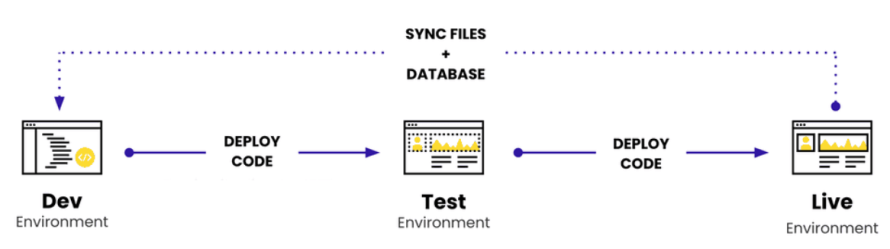
Code moves up (Dev → Test → Live). Content moves down (Live → Test → Dev).
This simple pattern removes the uncertainty of traditional hosting, prevents accidental data loss and gives teams a predictable, repeatable release process.
With Pantheon, you’ll also benefit from core productivity features such as:
- Autopilot: Autopilot updates WordPress/Drupal core, plugins/modules and themes automatically – testing everything with Visual Regression Testing to catch layout issues before deployment. Franklin College cut update time from three days to 90 minutes.
- Multidev: Every feature branch gets its own full site clone – code, database and files – so developers, designers and stakeholders review real previews, not screenshots. This eliminates staging-server bottlenecks and accelerates approvals.
- Quicksilver automation: Quicksilver runs scripts during workflow events – deployments, clones, cache clears – automating tasks like Slack notifications, database sanitization or search reindexing.
- Terminus CLI: Terminus enables scripting and bulk operations across many sites: creating environments, deploying updates, refreshing databases or clearing caches programmatically.
- Integrated Composer and New Relic APM: Composer modernizes dependency management; New Relic provides deep, built-in performance monitoring with zero setup.
By automating maintenance and standardizing workflows, Pantheon frees teams from slow, manual processes. Developers ship faster, marketers publish without friction, and organizations can maintain 99.99% uptime with far less operational effort. Pantheon doesn’t just make hosting easier – it makes entire teams more productive.
Making the right choice for your website
As you’ve seen, DevOps and WebOps aren’t competing methodologies. They’re complementary strategies that address different layers of digital operations.
Pantheon is purpose-built to make this convergence possible. With automated updates, production-ready workflows, powerful collaboration tools and a platform engineered for speed and uptime, Pantheon enables teams to ship faster, maintain quality and focus on meaningful digital impact.
Ready to modernize your website operations? Start building on Pantheon today and unlock the full potential of WebOps!