
Best Cheap Drupal Hosting
Cheap Drupal hosting can be misleading – many low-cost plans cut corners on performance, security, and the infrastructure Drupal actually needs to run well. That’s why, in this guide, we break down the real costs behind popular budget hosting options, where shared hosting can work for small sites and when upgrading to a managed platform delivers better long-term value.
Cheap shared hosting that works for small Drupal sites
Shared hosting can be a reasonable starting point for low-traffic Drupal sites – personal projects, brochure sites or early-stage businesses – as long as the host supports modern Drupal tooling like Composer, Drush and basic caching.
Here’s how the most common budget options perform in practice.
Hostinger
Image
Hostinger positions itself as one of the lowest-cost entry points for Drupal hosting, with plans starting around $2.99/month (for 12 months) and a one-click Drupal installer through its custom hPanel interface. Under the hood, you get Nginx-based caching, HTTP/2 support, free SSL certificates, DDoS protection and access to a global data center network – solid fundamentals for a budget host.
However, the biggest limitation for Drupal users appears immediately on the cheapest plan because there is no SSH access. Without SSH, you cannot run Composer to manage Drupal core and contributed modules, and you cannot use Drush for updates, cache rebuilds or site maintenance. This effectively locks you into outdated manual workflows. Once you upgrade to the Premium tier or higher, SSH becomes available (restricted to your home directory but sufficient for Composer-based installs).
Performance-wise, Hostinger shared plans do not include Redis or Memcached, meaning Drupal’s database and render caching is limited unless you manually configure alternatives or move to VPS hosting.
SiteGround
Image

SiteGround’s servers are configured to meet Drupal’s requirements, including Apache with mod_rewrite enabled, multiple PHP versions, high PHP memory limits, and support for MySQL, MariaDB and PostgreSQL out of the box.
SiteGround plans start at $2.99/month (for a 12-month period, then renews at $17.99/month) and include SSH access, which means Composer and Drush workflows work immediately with no hacks or workarounds. All plans include free SSL and NGINX-based static caching. The GrowBig and GoGeek tiers add Memcached, which significantly improves Drupal performance by caching database queries and rendered objects. The GoGeek plan also includes Git integration for basic deployment workflows.
Hosting (formerly A2 Hosting)
Image
With Hosting, you get preconfigured PHP settings, OPcache enabled, MySQL query caching, one-click Drupal installs, Composer access, Drush support, free SSL, malware scanning and free migrations.
The lower-tier shared plans (starting at $3.99) are fairly standard and don’t outperform competitors in meaningful ways. The real performance improvements come from Hosting’s Turbo Boost and Turbo Max plans, which use LiteSpeed web servers and NVMe storage for noticeably faster page rendering.
DigitalOcean
Image
DigitalOcean operates in a completely different category from traditional shared hosting. Instead of preconfigured hosting plans, you get virtual private servers called Droplets starting around $4/month – essentially a blank Linux machine with full root access.
This gives you dedicated compute resources and full control, but it also means you manage everything: web server setup (Nginx or Apache), PHP configuration, database tuning, firewall rules, SSL certificates, backups, monitoring, OS updates and Drupal installation itself. There is no control panel, no one-click installer and no application-level support.
While even a small Droplet offers more predictable performance than shared hosting, realistic Drupal usage usually requires 1–2 GB RAM ($6–$12/month) to comfortably run Composer and serve traffic.
Management tools like RunCloud, ServerAvatar or Cloudways can simplify server administration, but add cost.
When managed platforms are a better value
Cheap hosting looks appealing because the monthly price is low. But with Drupal, the hosting bill is only part of the real cost. The higher cost is the time and effort it takes to keep the site running smoothly.
On shared hosting or a basic VPS, you’re responsible for most of the technical work. You install updates yourself. You fix things when an upgrade breaks. You set up caching to keep the site fast. You handle backups, security patches and traffic spikes. None of this is complicated on its own, but over time it adds up, especially as your site grows.
Managed Drupal hosting platforms like Pantheon take that work off your plate with:
- Separate environments to test changes before going live.
- Handling backups and security behind the scenes.
- Built-in performance tools so your site stays fast without extra configuration.
- Auto-scaling as traffic increases.
For small personal sites, cheap hosting is usually fine. But for business sites, client projects, or anything where reliability matters, managed platforms often end up being the better value. You pay a little more each month, but you save hours of troubleshooting, reduce risk, and get a setup built specifically for Drupal instead of forcing Drupal to fit generic hosting.
The Drupal on Pantheon advantage
Pantheon is a managed Drupal platform built around WebOps workflow, which means performance, security and reliability are part of the platform rather than things you bolt on yourself. Every Drupal site includes:
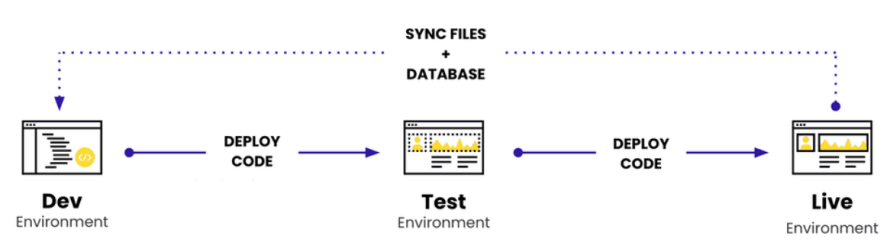
- Separate Dev, Test, Live environments so changes can be built, tested and launched without risking production stability. Code moves upward through Git-based deployments, while content can be cloned down to create realistic pre-production testing.
Image
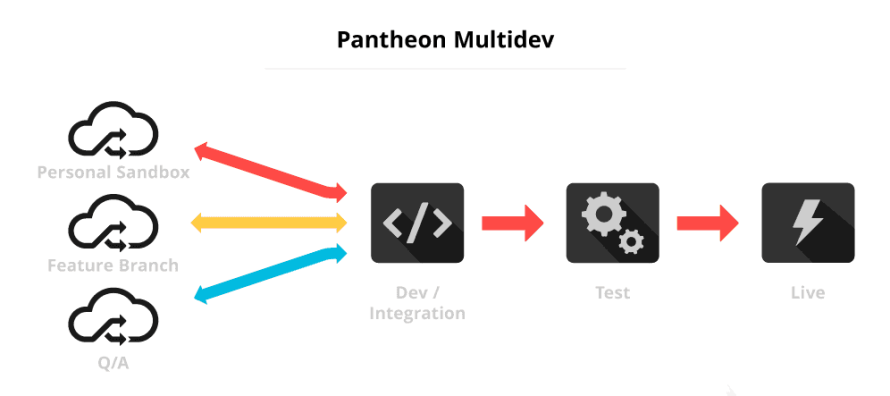
- Multidev, which lets teams spin up additional full Drupal environments for individual feature branches or experiments. Instead of everyone sharing one Dev space and stepping on each other’s work, each feature can live in its own isolated environment with its own database and files. This makes parallel development safer, speeds up reviews and prevents half-finished work from breaking main development.
Image
- A global CDN with built-in edge caching, automated HTTPS across all domains, a web application firewall (WAF) and DDoS protection. These are preconfigured for every environment, so you don’t manage cache rules, certificates or separate security services.
- Simplified updates and automation through Quicksilver and the Terminus CLI. Built-in
- New Relic monitoring for performance visibility.
- Redis object cache and Varnish page cache.
The practical difference between a managed Drupal hosting provider and a cheap option is simple: instead of assembling hosting, security, performance, backups and workflows yourself, Pantheon delivers them as a single Drupal-optimized system. That’s what turns a higher monthly cost into lower operational risk and time spent fixing things.
Choose affordable performance with Pantheon
Cheap Drupal hosting can work for small, low-risk sites, but as soon as a site supports a business, a team or real traffic, the true cost shifts from monthly hosting fees to time, stability and risk. Shared hosting saves dollars upfront while quietly adding hours of maintenance, performance tuning and firefighting.
Pantheon flips that equation. Instead of stitching together servers, caching layers, security tools, backups and deployment workflows, you get a Drupal-optimized platform where performance, reliability, and safe releases are built in from day one.
So, for teams that value speed, uptime and predictable growth, Pantheon isn’t the expensive option – it’s the efficient one.
Start your Drupal site on Pantheon and spend your time improving experiences instead of managing infrastructure!