The Future of AI Search: 3 Tips for Getting LLMs To Recommend Your Brand
Image
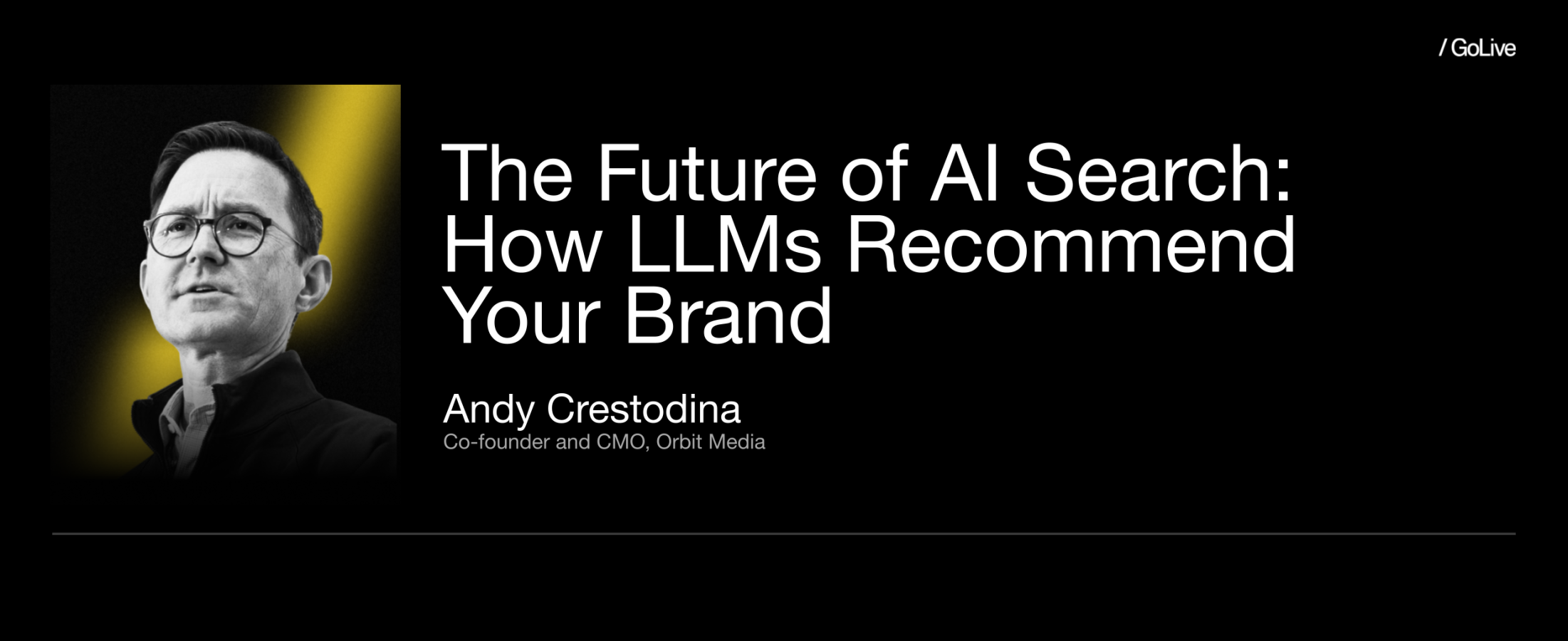
We founded our digital agency 25 years ago. For me, that’s pretty much half a lifetime doing SEO, web development and analytics. Now I am immersed in AI research, looking for new marketing methods and studying the changes to buyer behavior.
At Pantheon's GoLive conference, I made the case for a new approach to AI search optimization. Here's the short version of that session, plus three methods that align with this new way of thinking.
It’s all based on this one huge shift in digital marketing: your buyer is researching options within the LLM. They do their consideration-stage thinking inside the model now. This is perfectly obvious when you consider these two data points:
- Prompts are way longer than queries.
A Google search is maybe 4-6 words long. A prompt is often 50 to 70 words. So what's in all those extra words? Their situation. Their constraints. Their concerns. Their story.
- Visitors from AI convert at much higher rates.
I used Apps Script to pull data from 97 GA4 accounts, across 29 million sessions and discovered that visitors from AI sources converted at three times the rate of traffic from other sources.
Traditional search gave people options (a list of links). But AI gives them a recommendation (within a conversation). Therefore, the brands that win won't be the visible ones. They are the ones that get recommended.
Cheese and mousetrap: AI search is the intersection of SEO and CRO
For years, there were two different digital marketers working together on organic lead generation.
- Search optimizers brought the visitors. They're the cheese marketers.
- Conversion optimizers turned visitors into leads. They're the mousetrap marketers.
Separate jobs. Separate teams. Separate mindsets. But now that the consideration stage now happens inside the model, AI search marketers have to think about both the cheese and the mousetrap.
As I mentioned, I myself am an SEO. I have huge respect for the profession. SEOs know what wins rankings …but they aren’t famous for knowing what wins the sales call. They often don’t think much about conversion optimization.
Image
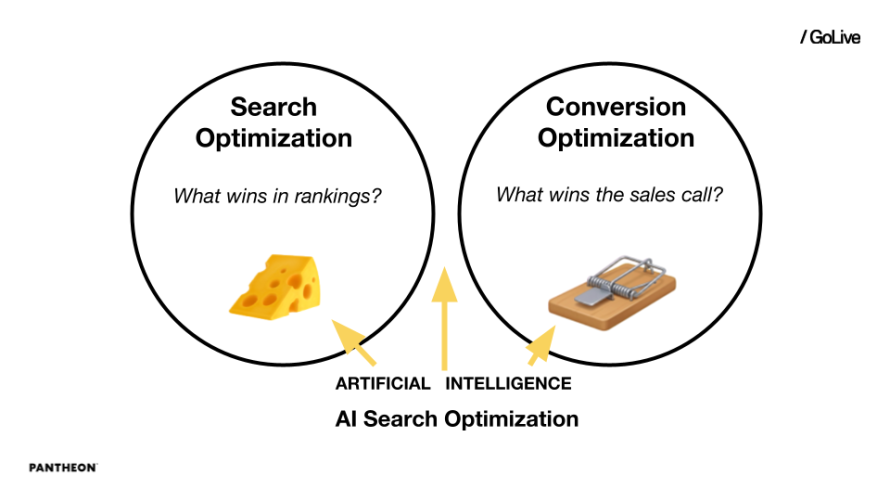
No surprise, SEOs talk a lot about AI visibility. But AI visibility really isn’t the goal. The goal is AI recommendations. And to win AI recommendations, you need to think differently about your web content.
Your website needs to train AI to be a sales rep for your brand.
Imagine you're training a new rep. What would you tell them? “Here's what people ask. Here's how we answer. Here's the objection and how we handle it. Here's the proof that earns their trust.” Obviously, you don't train a sales rep by giving them keywords.
The training is already happening, right now as you read this. AI bots are crawling your site today. Probably, they’re on the homepage. We looked at 27 pro-tier Cloudflare accounts and found that AI bots visit homepages 15 times more than any other type of page. Wow.
Image
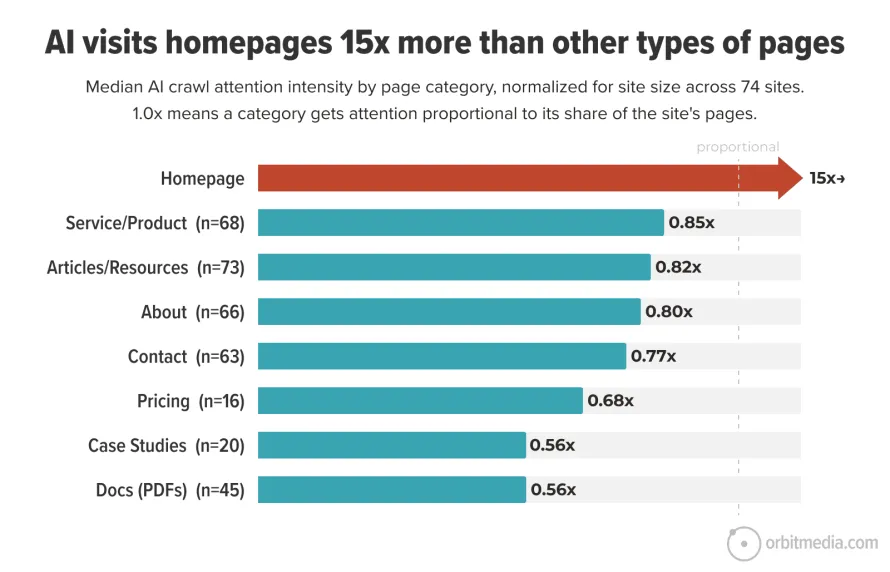
Source: AI Crawl vs. Traffic Report
The question for marketers and website copywriters is: what aren't they finding?
Let’s walk through three SEO best practices for AI search and take them farther. Far enough to improve our chances of winning a recommendation from AI. Here are three ways to go beyond typical SEO approaches to AI search.
1. Beyond FAQs: Find the questions buyers actually ask
You hear it everywhere. It’s almost a universal consensus. “LLMs love FAQs.” It makes sense that a common language structure (questions and answers) would align well with how a language model understands brands. But where do the SEO blogs say to find your FAQs? SEO articles often suggest the these sources:
- SEO tools
- The People Also Ask box
- Competitor FAQs
- Ask AI
But none of those are your buyers. When I ask any of my SEO tools what questions people ask about our services, I get a long list. But I promise you nobody on a sales call has ever asked them.
The real frequently asked questions are in your sales calls. Thanks to COVID and notetakers, most of those calls are recorded. That's a goldmine of first-party, voice-of-customer data, and no SEO tool can touch it.
The simple version:
- Copy the transcripts out of your notetaker.
- Merge them into one markdown file.
- Add that file to an AI project.
- Ask it: What do prospects ask us? What do they need to know before they buy?
When I did this with 90+ sales calls, I had a collection of nearly 2,000 questions. Budget. Scope. Teams. Timelines. Technology. Outcomes. These are the questions we need to answer. This is what our web copy needs to cover if we’re to have any hope of aligning with our buyer’s prompts.
No recorded calls? No problem. Talk to your sales team. Ride shotgun on a few calls. The goal is the same: data-driven empathy.
If these questions are truly frequently asked, why are they in a little box at the bottom of the page? An FAQ isn't a format. This isn’t about the little box. It's the structure of the page. Prospect asks a question, salesperson answers it, that answer becomes website copy, that copy trains the AI.
2. Beyond Schema: Use tag libraries to find what's missing
Here's a question. What would better train AI to recommend you?
- A thin page, beautifully tagged with schema
- A rich, detailed page with every answer your buyer needs, and no tags at all
Schema has its place. But flip it around. Instead of using schema to tag what's on the page, use schema.org as a giant checklist of what could be on the page. Give AI the page and ask it which schema types fit, which properties are missing, and where that content could go.
The gaps jump out:
- HowToStep: The page never explains the process.
- Service output: The page never describes the outcomes.
- Review: The page never supports its claims.
- Audience: The page never says who it's for.
- Related services: The page never mentions what else you do.
Funny thought. If AI can add schema to your page for you, why does AI need schema to understand your page?
3. Beyond E-E-A-T: Support every claim with evidence
When Google's quality rater guidelines told SEOs to add experience, expertise, authority and trust, SEOs everywhere started adding proof to their pages. Conversion optimizers scratched their heads. Weren't you doing that already? For the visitor?
Talia Wolf puts it well: "Trust is the perceived probability that choosing your brand won't end in regret."
And Flint McLaughlin of MECLABS explains why this matters even more for AI: machines prefer options with high clarity, high corroboration and low ambiguity, because they want to reduce the risk of recommending incorrectly.
So here's the test. Read your service page. Could a startup born yesterday write the same copy? If so, you have an evidence problem.
Look at the difference in the copywriting for this engineering website:
| Unsupported claim | Supported claim |
| “We help customers design, maintain and optimize through engineering expertise.” | “Backed by experienced engineers, technicians and product specialists.” |
| “500+ systems engineered. Thousands of customers served since 1990.” | “40+ specialists, including IFPS-certified fluid power engineers.” |
| “Integrated hydraulics, pneumatics and engineering solutions” | “35 years of experience in hydraulic systems and the largest certified service team in the Midwest.” |
To find your own unsupported claims, take a full-page screenshot of the page and give it to AI with a prompt that lists every claim lacking evidence. Screenshots beat code for this. AI can see the visual hierarchy, and it'll spot the trust seal that never appeared in the HTML.
While you're at it, put your strongest proof right next to the claim it supports. Don't bury it on a case study page that nobody clicks.
Align the page with your buyer's moment of truth
SEOs look for gaps between their site and their competitors. Or between their site and best practices. Twelve red dots in the audit tool? There's your to-do list.
Conversion optimizers look for a different gap: the gap between the page and the buyer. And if you don't know what your buyer cares about, how could AI ever match you with them?
You'll never guess every prompt. You don't need to. You just need to understand the person writing it. Here's a simple two-step method.
- Build the persona. Prompt AI for your buyer's role, company, decision criteria, pain points and objections. Is it wrong? Probably. Fix it. Work hard on it. Save it as a markdown file, not a slide deck, because it becomes the input for everything else.
- Run the alignment audit. Give AI the persona and a full-page screenshot. Ask: What's missing from this page from this buyer's point of view?
When I ran this on an industrial services page, the scores were humbling. The buyer wanted proof of relevance in their industry. Two out of five. No mention of food processing, packaging or wastewater. The buyer wanted a fix for recurring part failures. Two out of five. Nothing about troubleshooting or long-lasting replacements.
Treat the output as a point of view, not a source of truth. Don’t assume it’s correct. You're the human in the loop. Look closely. You decide what belongs on the page.
The result is a page that works like a great sales call. It covers the problem. The approach. Who it's for. The objections. The evidence. The outcome. And the next step.
Here's something strange I see in GA4 path explorations all the time now. The most common conversion path is homepage, contact page, thank you page. They didn't need the other pages. AI already told them who you are.
From “SEO Professional” to “Credibility Engineer”
Everyone loves AI for efficiency. “Look, I one-shotted this! Check out how fast this was!”
But I'm not here to find efficiencies. I'm here to find deficiencies. I’m much more focused on finding gaps between what your buyer needs to know and what your page actually says.
SEOs think about gaps between our site and our competitors. But now we need to spot the gaps between our content and our visitors. Because our goal isn’t AI visibility, it’s AI recommendations.
That's the shift:
- Keywords → sales clarity
- Links → third-party corroboration
- E-E-A-T → evidence for every marketing claim
- Winning rankings → winning recommendations
- SEO professional → “Credibility Engineer”
Traffic may keep going down. That's fine. You don't need all the visitors in the world. You need the qualified ones. And AI will send them, if you give it reasons to believe you're the right fit.
Keep going
Watch my full GoLive session, The Future of AI Search: How LLMs Recommend Your Brand, for all the prompts and examples.
Read Pantheon's Architecting an AI-Ready Website ebook for a practical framework on preparing your site for AI search.