No One Asks a Thermostat to Show Its Work. AI Agents Should.
Image
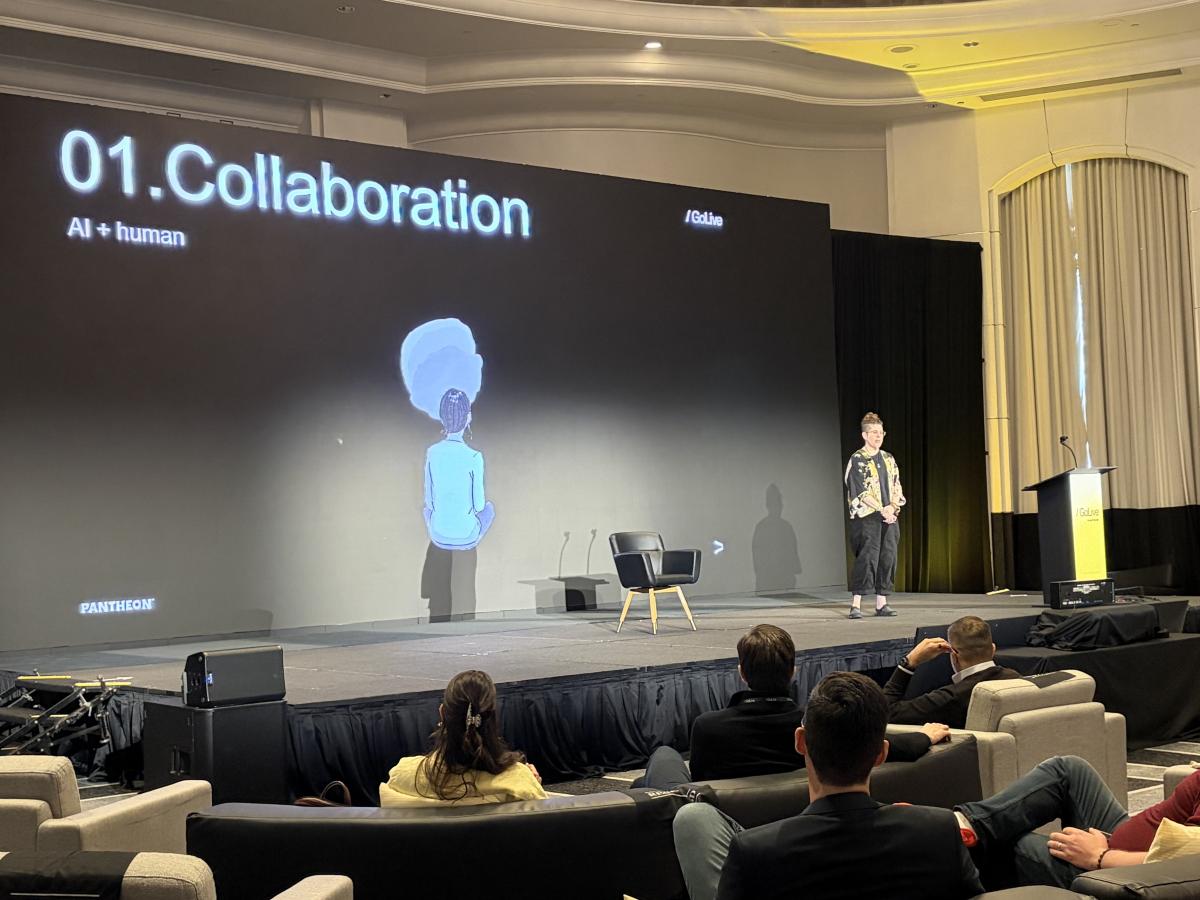
A chair was brought onto the stage for Tammie Lister, product engineer and designer.
She hadn’t asked for one, and she didn’t sit down. I kept thinking about it: the object we add because we assume it belongs there. It felt like a metaphor for AI in our lives. We keep bringing AI into our workflows – sometimes thoughtfully, sometimes because it’s now expected. And then we call the result “human in the loop.”
Meaningful human involvement begins when the person has a real role in the work. Hence the thermostat analogy in the title. You can’t set up AI and forget it; you need to see what’s inside.
How Calm Technology applies to AI
Why a thermostat? Tammie Lister, Chief Product Officer at Convesio, brought it up during her talk “The Human in the Loop Means Something” at Pantheon’s GoLive conference. A thermostat can quietly regulate a room. An AI agent acts on our behalf and makes decisions. That means calm is not the same as passive.
Tammie connected that distinction to Calm Technology, a body of work about systems that inform people without demanding their constant attention. The idea was developed for a world in which computing would surround us. In the AI era, it becomes a question of how systems act on our behalf. Watch Tammie explain this.
Calm does not mean silent or invisible. It means the system communicates its status, makes space for questions, and lets a person step in when judgment matters. Tammie described those properties as informative, queryable, and interruptible.
The standard is that a human can intervene early enough, often enough, and with enough context to make a difference.
A loop creates space for collaboration
Tammie’s point was simple and useful: a human-in-the-loop system puts a person in the work throughout, with a meaningful role across the beginning, middle, and end.
It’s not a process. It’s not a diagram. It’s not a checkbox with its start and the end. It’s not a moment of approval.”
— Tammie Lister, CPO, Convesio
The loop is the space where collaboration happens. That means the person reviewing an AI-generated output needs enough information to understand what happened, enough context to question it, and enough authority to change course.
That design turns the reviewer into a participant with a real role.
No more AI slop: Give reviewers something meaningful
This is how we counter AI slop. Next time you send someone a 75-page deck, tell them how the system got there, what assumptions it made, and how it would be relevant for the market, industry, vertical or persona you are serving. A meaningful review should now start with more than a polished answer.
Tammie described this as a system being informative: it shows what it is doing along the way as well as reporting the result.
That distinction matters. An explanation becomes useful when it arrives while decisions are still open. A reviewer who sees the work as it develops has the evidence needed to apply judgment.
With content volume rising faster than human attention, we need a better workflow. If AI produces 40 items for review and marks them all as acceptable, the workflow needs context and prioritization so the reviewer can focus judgment where it matters.
Keep the human work in the loop
There is another pattern to watch for. We accept the answer, move on, and gradually stop doing the thinking that makes our judgment valuable in the first place.
Tammie described what happens when we give AI too much agency: we become ghosts of ourselves and our work – cheap Halloween costumes that are fun for one day. Watch this clip to see her paint the scene all too familiar.
That is the line I want to carry forward. AI can remove toil while people retain accountability. It can bring scale, speed, and pattern recognition. People bring context, judgment, taste, responsibility, and the ability to recognize when a different direction serves the work. If you are spending hours (and tokens) down the rabbit hole questioning everything you’ve already created, this is your sign to stop. Go back and design the system for collaboration and meaningful review.
Three questions for designing human-in-the-loop systems
Tammie’s advice for adding AI to a workflow is threefold. We should ask:
- Can a person see what the system is doing now as well as what it did afterward?
- Can they ask why and receive a useful answer?
- Can they intervene at any point where their judgment matters?
When all three answers are a yes, that chair onstage has a purpose: the human is in the loop with information, questions, and agency. Human control is not the opposite of AI speed. It is what makes AI speed work.
That is Pantheon’s “move fast, stay in control” point of view in practice – and a useful test of whether your web operating model is ready for the AI era. For more context, read P1: A Fresh Start for Web Builders in the AI Era.
Watch Tammie’s talk in full to get your thermostat in order.