The Way We Run Websites at Scale Is Broken. What Comes Next?
Managing websites at scale has never been an easy task, and AI is making it dramatically worse.
Wait, what?
Not the websites themselves. Actually, it's easier and faster than ever to whip up a good-looking website, especially for non-technical folks…thank you, Claude.
What's broken is everything around these sites: security, consistency, governance, maintenance. Where it gets worse is if you are running a fleet: a few, dozens, hundreds, sometimes thousands of sites across brands, departments, and frameworks. And every tool you've been given to do that job was designed for exactly one site at a time.
This blog is about that mismatch, a cost that teams pay every day, and how Pantheon is helping to cover that gap.
Risk and Governance, at Scale
Managing tools at the site level is risky in the age of AI exploitation.
A critical vulnerability doesn't land on one site; it lands on multiple, and you find out how many by checking one dashboard at a time.
A bot making 10 requests to one site is noise; that same bot making 10 requests across a hundred sites is an attack pattern, and it's been completely invisible because nothing in your stack looks across the fleet.
The most important operational questions a web team faces—what's out of date, what's at risk, what's eating our capacity, who has access to what—are fleet-level questions, and the industry keeps answering them with site-level tools.
The clock on those questions just got shorter…permanently.
AI has changed how sites get attacked
AI-assisted security research is uncovering vulnerabilities at a pace no human team could match, as the models never get bored. wp2shell, the most serious vulnerability in the history of WordPress, went from disclosure to weaponization in under eight hours. That's the new baseline: the window from CVE to exploit is now measured in hours, not days.
And at fleet scale, every one of those events starts as an inventory problem before it's a security problem: which sites are affected, who owns them, how fast can we touch all of them? If answering that takes a spreadsheet and a weekend, you've already lost the race.
Web teams have a high-maintenance governance problem
Walk into any organization running websites at real scale, and you'll find the same shadow infrastructure: scripts that loop through sites one by one, spreadsheets tracking which version runs where, homegrown dashboards duct-taped to CLI output.
Nobody wanted to build this. They built it because the information required to run a fleet safely has never lived in one place, in the form a human—or a script—could actually consume.
There is a fleet-level vendor gap
Vercel is Next.js-first, Automattic is WordPress-first, and Acquia is Drupal-first. They are tightly coupled to their frameworks, leaving a diverse fleet as an afterthought.
When a platform is built for a specific framework, fleet-level operations are deprioritized, making the burden of running a fleet at scale more severe for web teams and leaders.
AI has changed how websites get built, but the hard work remains
Vibe coding and agentic building are the biggest unlock the web has ever seen: anyone can ship, ideas become pages in minutes, the whole team builds.
Which means fleets are about to get bigger and change faster than at any point in the web's history…while the operational model underneath them is still "log into each site and check." More sites, more builders, faster attacks, same one-at-a-time controls.
Era of AI, Era of AFM (Agentic Fleet Management)
Agentic fleet management (AFM) allows you to observe and operate everything you run—every site, team, brand, and framework—through one pane, with information trustworthy enough that both humans and AI agents can act on it.
At Pantheon, we’re thinking about your whole fleet.
Agentic Fleet Management turns the fleet from 50 things you visit into one thing you operate.
- See traffic, updates, performance, and access across the whole estate.
- Take action at scale: apply the update everywhere, delegate a site without over-provisioning, set the rules once and enforce them across the fleet.
Q3 Product Announcement: Agentic Fleet Management
This quarter's releases are the opening chapter, and each one attacks a specific gap named above.
At fleet scale, your biggest traffic problems are the ones you can't see. A bot swarm hammering one site, a traffic spike quietly inflating your bill, a slow bleed of performance across a dozen properties—none of it shows up when your only options are stitching together CDN logs, per-site dashboards, and client-side analytics that bots don't even trigger. The attack pattern is invisible precisely because it's spread across your fleet.
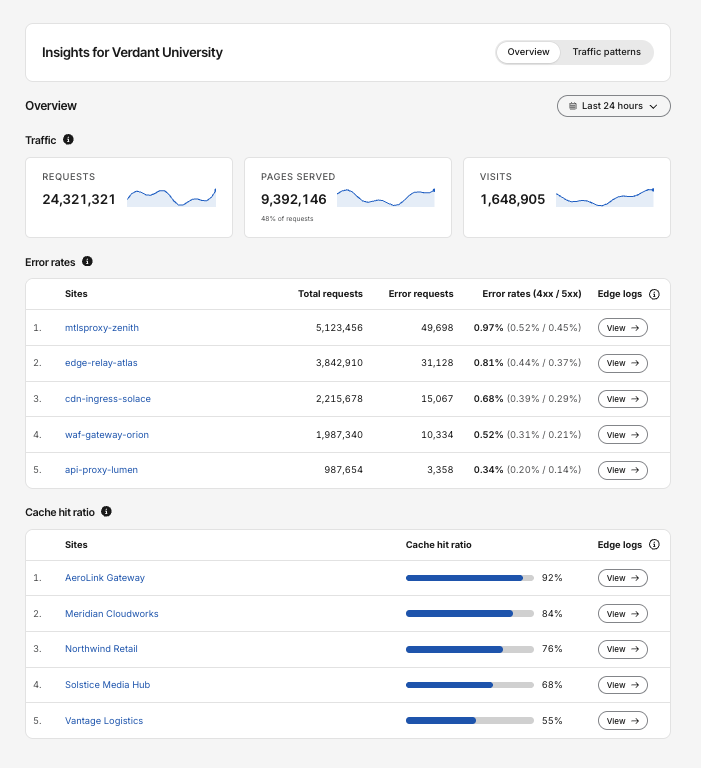
Fleet-Level Traffic Insights makes it visible. Traffic, deployments, and performance for every site in one workspace view, built on server-side numbers you can trust, so you finally know what's real traffic, what's bot noise, and what's actually driving your bill. When something spikes, you can see where, correlate it with what shipped, and act. No log-stitching, no guesswork, no surprise invoice.
The New Site Administrator Role
Until now, giving someone real control over a single site meant giving them too much—either broad permissions that make your security team wince, or bottlenecking every team change and deployment through the few people who hold the keys. At fleet scale, with dozens or hundreds of sites, agencies, and distributed teams, that trade gets expensive fast.
The new Site Administrator Role fixes it. Hand a single site to the right person (or people) and they get everything they need to run it—their team, their deployments, their day-to-day operations—without visibility into billing, access to other sites, or the power to delete anything. It's a least-privilege delegation that clears security review instead of triggering it, with no added cost and no migration. Assign the role and you're done.
Next-Generation Global CDN, now Generally Available.
Edge security has always been someone's job. At fleet scale, that's the problem. Configuring bot rules site by site, bolting on a third-party CDN, tuning WAF policies that drift out of date the moment traffic patterns shift: it's toil that scales linearly with your fleet, and every unpatched gap is an open door. Meanwhile, scrapers and bots keep getting smarter, hammering origins, skewing analytics, and driving up costs on sites nobody's watching closely.
The Next-Generation Global CDN, now GA, hardens the edge for your whole fleet at once. Bot protection is on by default, malicious scrapers are challenged before they ever reach your origin, and performance gets steadier under load, with no rules to configure, no policies to maintain, and no third-party CDN to bolt on or pay for. Every site you run, and every site you launch next, is protected from day one.
Coming Soon: Your Fleet, Actionable by Agents
The next phase makes your fleet completely visible to and actionable by the agents and automation your team uses, with the guardrails and governance needed for critical websites.
Bulk Upstream Updates kills the loop-through-every-site script, and answers the question every security team is now asking: if a critical CVE dropped tomorrow, how long until every one of your sites is patched?
Push an Upstream update across your whole fleet in one action. See which sites have pending updates and apply them in bulk, collapsing a multi-hour, multi-tab chore into one coordinated move.
When the exploit window is eight hours, fleet-wide patching in one action is the difference between an incident and a non-event. It works for external-VCS sites too, opening a pull request to your GitHub or GitLab repo so your team keeps full control of the code.
MCP (Model Context Protocol) is the emerging standard for connecting AI agents to the systems they work with.
A Pantheon MCP server means the AI tools your team already uses—LLMs, coding agents, internal automation—can connect directly to your fleet: ask which sites have pending security updates, pull traffic anomalies across the fleet, inspect what changed and where. The same fleet intelligence in your dashboard, available wherever your agents live.
Public API for fleet operations
Everything we surface at the fleet level will be programmable. Visibility that only exists in a screen is visibility your automation can't use, so the API surface for fleet-level data and operations is first-class, not as an afterthought.
This is also why we're investing in the unglamorous foundations, like access tokens with timebound expiry and instant revocation, because a usable API surface must also be secure.
Agent sandboxes and agentic operations
Pantheon's Dev, Test, Live model has always meant every change gets a safe place before it touches production. Agent sandboxes extend that same principle to AI: isolated environments where agents can do real work on your code—and where their changes are reviewed, gated, and promoted with the same rigor as any human's.
The web is entering its fastest-moving era ever…on both offense and defense.
The teams who win it won't be the ones with the most sites. They'll be the ones who can actually operate them.
What You Can Do Now
At Pantheon, we already run the fleet, and have for 16 years. Pantheon’s immutable production filesystems, version-controlled Dev/Test/Live workflows, global edge, and platform-wide security controls make every site’s state provable, every change auditable, and every action’s blast radius contained.
That foundation is what makes agentic fleet management safe.
We’re not bolting intelligence onto someone else’s infrastructure; we’re bringing intelligence to the platform we already operate. Our customers asked for it because they’re ready to leave behind the feature requests, support work, and shadow tools they never wanted to manage in the first place
Here’s what you can do now.
On Pantheon? Open your workspace. Traffic Insights are live today in the Dashboard, with Bulk Upstream Updates coming in Q4. You can move your sites to Next-Generation Global CDN today too.
Running a fleet somewhere else? Ask your platform three questions: Can you see every site in one place? Can production code change without review? If a critical CVE dropped tomorrow, how long until every site is patched? If the answers sting, talk to us.
Either way: Join us at /GoLive in Miami, October 6–7 to see what's next…including your fleet becoming as legible to agents as it is to you.
P.S. Our customer roadmap is open. Tell us what needs to be a part of this.