The AI Exploitation Era: Why Legacy WordPress Hosting Is No Longer Enough
The security landscape shifted permanently with the disclosure of the wp2shell exploit chain on July 17, 2026. Uncovered by Adam Kues of Searchlight Cyber's Assetnote research team and reported through WordPress's HackerOne program, wp2shell exposed multi-step logic flaws in WordPress core that had gone unnoticed for years.
The method matters more than the bug. Kues did not find the chain by hand: he pointed a frontier reasoning model at the WordPress codebase for roughly ten hours of model time, at a compute cost of about $25, having instructed it to ignore changelogs and patch diffs and hunt for pre-authentication remote code execution paths. His own assessment was unambiguous. No security researcher, he said, could have found and completed that exploit chain in ten hours without AI.
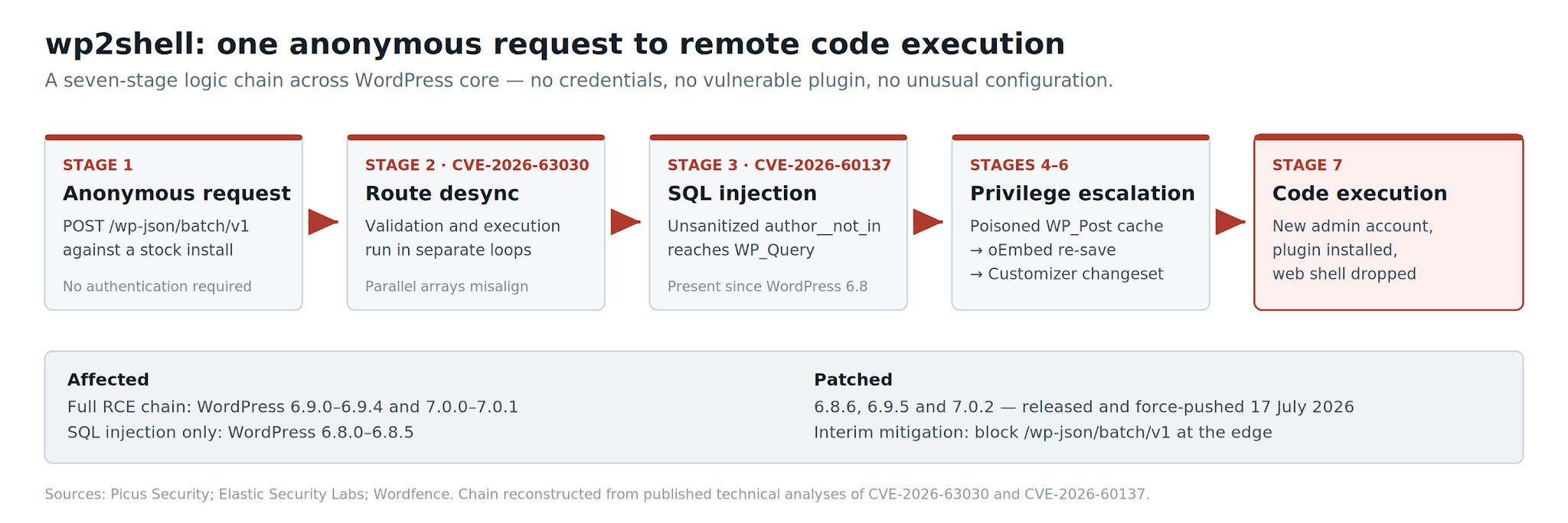
This was not a typo or a missing escape character. It was a seven-stage logic chain spanning multiple core files. No credentials, no vulnerable plugin, no unusual configuration: one anonymous HTTP request against a stock install. The SQL injection reached back to WordPress 6.8. The full RCE chain affected 6.9.0 through 6.9.4 and 7.0.0 through 7.0.1, and was patched in 6.8.6, 6.9.5 and 7.0.2, which WordPress force-pushed to sites with automatic updates enabled.
wp2shell is not an isolated incident. It is a preview of how quickly the window between disclosure and mass exploitation is closing. Within roughly 48 hours of the patch, researchers had verified more than two dozen distinct public proof-of-concept exploits, honeypots were recording tens of thousands of exploitation attempts, and different threat actors had created over a hundred backdoor administrator accounts. One security firm rebuilt a working exploit from nothing but the published clues in six minutes, using an AI coding agent. Both CVEs were added to CISA's Known Exploited Vulnerabilities catalog on July 21, four days after disclosure.
These developments should be, and are, scary.
As AI tools democratize zero-day discovery, the speed and scale of attack vector generation have breached what human security teams can handle manually. Securing modern web properties requires moving beyond legacy hosting models and adopting a modern, AI-ready security architecture.
The Failure of Traditional SAST and the Rise of AI Reasoning
For years, mature organizations relied on standard Static Application Security Testing (SAST) and Dynamic Application Security Testing (DAST) tools as best-practice gatekeepers. Those controls did not surface wp2shell. The SQL injection had been sitting in WordPress core since version 6.8 and the batch-route flaw since 6.9, inside one of the most heavily scanned, audited, and bug-bountied open-source codebases in existence.
The reason is structural. Traditional SAST relies largely on localized pattern matching and taint analysis within specific functions or files, looking for known bad signatures. What it does not do well is trace complex inter-file execution flows, cache and object-state changes, and subtle logic desynchronizations across an entire codebase. Every individual step in the wp2shell chain looks defensible in isolation. Only the composition is dangerous, and composition is precisely what per-function analysis cannot see.
AI reasoning models are markedly better at exactly this. They can analyze code at a systemic level, connecting disjointed execution paths that human auditors and pattern-based scanners miss. Two caveats are worth stating plainly, because your board will ask. These models still generate false positives at volume and require expert triage, and wp2shell is one high-profile data point rather than a proven trend line. But the economics are hard to argue with: ten hours and roughly $25 is not a research budget; it is a rounding error, and that cost curve is what changes the threat model.
The Double-Edged Sword: "Vibe-Coding" and Automated Red Teaming
This shift is further accelerated by two converging trends:
- AI-Assisted Development ("Vibe-Coding"): As developers increasingly leverage AI tools for rapid refactoring and feature development, code velocity increases, often at the expense of strict architectural parameterization. Subtle logic flaws and unescaped paths slip into production at higher rates.
- AI-Driven Threat Actor Red Teaming: If your site, plugin, or custom code is connected to the internet, it is already being subjected to automated, AI-driven exploitation testing by threat actors.
Over the next 12 months, I expect AI-assisted zero-day discovery to concentrate on high-profile open-source projects, where the source is public, and one bug pays off across millions of installations, before expanding into the wider web software supply chain over the following 24 to 36 months.
Why Traditional WordPress Hosting Falls Short?
Legacy managed WordPress hosts, such as WP Engine, were built for an era of perimeter-based defense. Their security models lean heavily on signature-based Web Application Firewalls (WAFs), reactive file scanners, and routine patch management. One point deserves to be made honestly up front: no host was immune to wp2shell. The flaw was in WordPress core, so every WordPress site on every platform was exposed until it was patched. What separated a contained incident from a compromised one was not marketing claims but how fast the platform could patch, block, and detect.
In the AI era, this reactive approach creates a critical window of exposure:
- Signature Lag: When an AI agent discovers a deep, multi-step logic flaw in core code or popular plugins, traditional WAFs have no signature to block it on day zero. wp2shell is a useful test case here, because an effective interim rule did exist: block POST requests to /wp-json/batch/v1 and ?rest_route=/batch/v1 at the edge. That only helped organizations able to author and deploy a custom edge rule within hours of disclosure, rather than waiting on a vendor signature update.
- Perimeter-Only Focus: If an exploit bypasses the edge firewall, legacy environments often lack strict internal isolation, leaving the broader file system and server environment vulnerable to lateral movement.
- Manual Patching Windows: Waiting for manual analysis, vendor patch releases, and routine deployment cycles takes far too long when weaponized exploits can be generated automatically within hours of disclosure. The measured data bears this out. At disclosure, 60% of organizations running WordPress had at least one vulnerable instance and 25% had at least one vulnerable internet-facing server; those figures only roughly halved within 24 hours. In other words, a full day into active exploitation, half of all affected organizations were still exposed.
The Pantheon Advantage: Security Built for the AI Era
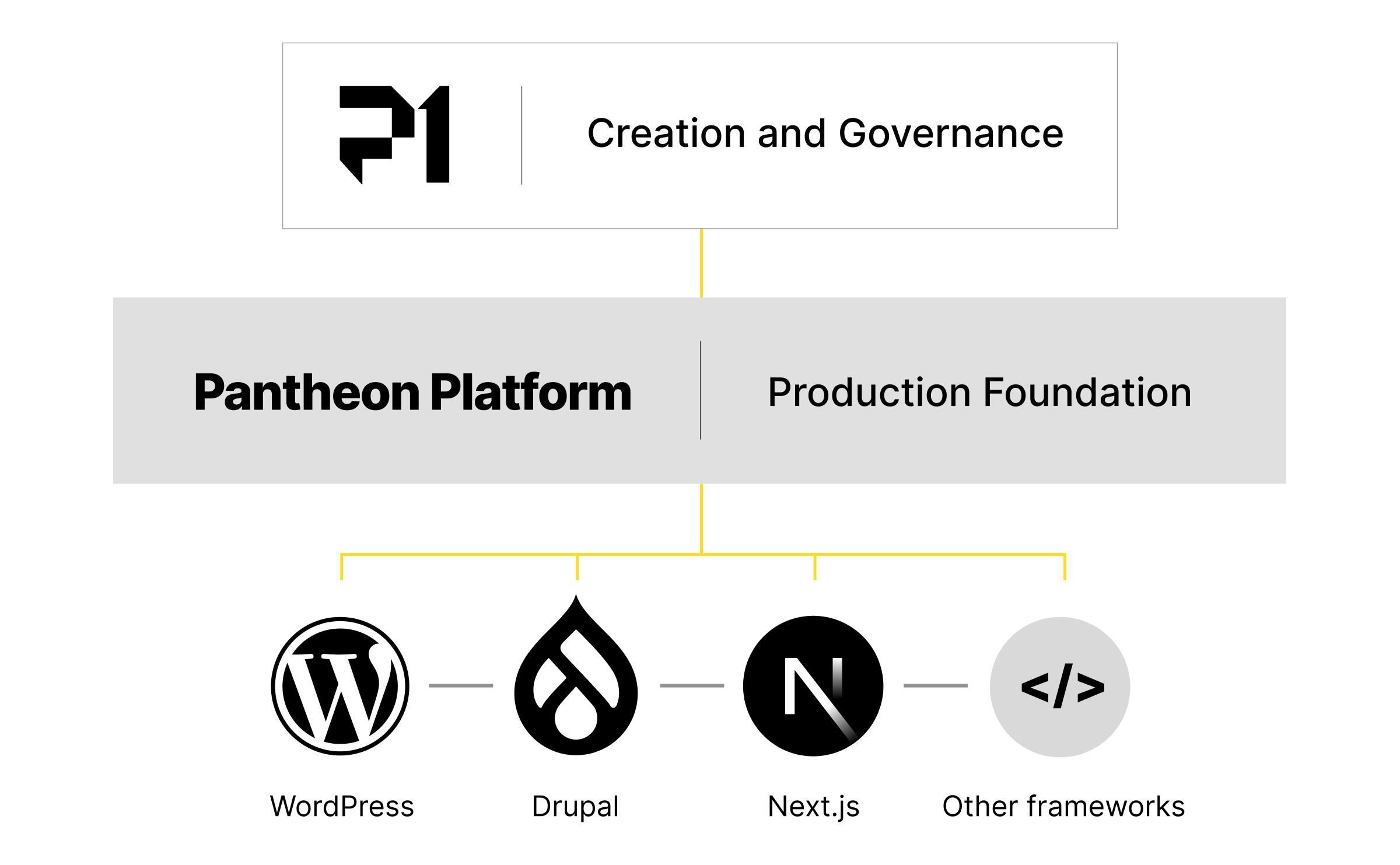
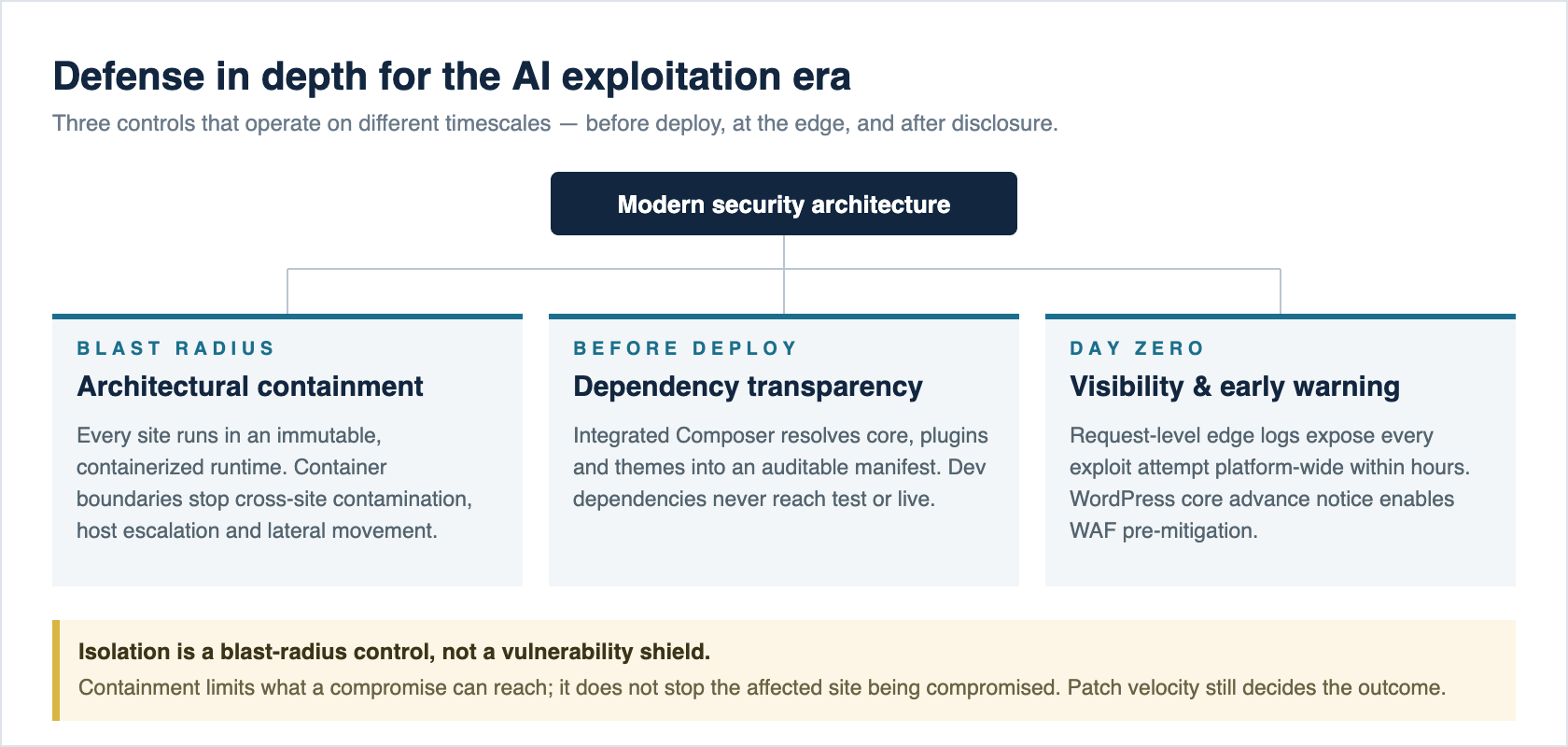
Navigating AI-driven vulnerabilities requires an architectural response, not just stronger edge filters. Pantheon approaches security through architectural containment, build-time supply chain transparency, and platform-wide visibility paired with early-warning mitigation.
1. Architectural Containment
Rather than relying solely on perimeter filters, Pantheon isolates every site inside an immutable, containerized runtime environment hosted on Google Cloud Platform. It is worth being precise about what isolation does and does not do, because a security reviewer will hold you to it. If a core logic flaw like wp2shell executes, strict container boundaries prevent cross-site contamination, host escalation, and lateral movement into neighboring environments. They do not prevent the affected site itself from being compromised. Isolation is a blast-radius control, not a vulnerability shield, which is exactly why it has to be paired with patch velocity rather than substituted for it. The attack chain seen in the wild is instructive: every publicly documented variant had to write to disk, staging a plugin archive under wp-content/uploads, unpacking PHP into wp-content/upgrade/, then installing a directory named wp2shell_<hex> into wp-content/plugins. Platforms that treat the application filesystem as immutable in production remove the most direct path to persistence.
2. Supply Chain Transparency & Build Integrity
Security must begin before code ever reaches production. Pantheon enforces version control, so WordPress and Drupal core, plugins, and themes are tracked as an explicit, auditable changelog rather than an opaque pile of files. Development dependencies are delivered only to Dev and Multidev environments and never reach test or live. Deployment secrets and API keys are held in the native Pantheon Secrets Manager, encrypted at rest and scoped by least privilege, rather than sitting in the repository. One boundary is worth stating honestly: custom code and the plugins you choose remain yours to secure, and no host can audit them for you. What the platform gives you is a precise, current inventory of what is actually running in every environment, which is the precondition for triaging a disclosure in hours rather than days.
3. Platform-Wide Visibility & Early-Warning Mitigation
Because AI enables threat actors to weaponize disclosures immediately, defensive systems must respond at the same speed. Pantheon retains request-level logs at the edge for every environment on the platform, and that visibility is what makes a fast, evidence-based answer possible during a live campaign. Within 24 hours of wp2shell going loud, we were able to isolate every exploit attempt against the platform by request pattern, HTTP method, source IP, target environment and response code, and to confirm that not one of them returned a successful response. Attackers can rename the dropped plugin, relocate the web shell into wp-content/cache, or write it directly via SQL INTO OUTFILE, but they cannot hide the request that delivers it. That is the question customers actually need answered on day zero, and a host without platform-wide edge visibility cannot answer at all.
Speed of mitigation matters just as much as speed of detection. As a direct follow-on to wp2shell, Pantheon established a channel of communication with the WordPress core security team and now receives advance notice ahead of security releases. We do not receive detailed information about what is in an upcoming release, but we are able to be on high alert, and in some cases the WordPress security team shares WAF rules that we can deploy to pre-mitigate, or virtually patch, an exploit path before the vulnerability becomes widely known. It is worth stating the limit plainly: there is no guarantee that every vulnerability can be mitigated by a WAF rule, or that a virtual patch will cover every possible angle of exploit. Platform-level defenses buy time. They do not replace keeping sites up to date.
What This Means for Your Next 24 Hours
If there is one operational lesson to take from wp2shell, it is to assume a working exploit exists before the advisory is even fully written. The sequence below is what teams that came through this cleanly actually ran.
Inventory every WordPress instance in scope, including the marketing microsites nobody told you about, and confirm the version actually running rather than the version you believe is running. Forced updates do fail silently.
Patch to 6.8.6, 6.9.5 or 7.0.2. Where patching cannot happen immediately, block POST requests to /wp-json/batch/v1 and the equivalent rest_route query parameter at the WAF, or disable anonymous REST API access.
Hunt, do not simply patch. Look for HTTP 207 responses from batch endpoints, user-agent strings such as wp2shell or cve-2026-63030, temp-write-test files under wp-content, unexpected PHP files in wp-content/plugins or wp-content/cache, and any administrator account or application password created inside the exposure window. Patching a site that is already compromised does not evict the attacker.
Ask your host three questions in writing: when did you patch, what did you block at the edge and when, and what can you show me from your logs. A host that cannot answer all three confidently is a finding for your next vendor review.
Securing Your Digital Footprint for What's Next
The speed of AI-assisted code discovery means that traditional "patch-when-notified" security models are obsolete. Organizations managing high-impact web properties can no longer rely on legacy hosting environments that treat security as an afterthought managed by static firewalls.
By combining containerized isolation, a mature SDLC for code management, platform-wide edge visibility, and coordinated early warning with the WordPress security team, Pantheon delivers the defense-in-depth infrastructure required to keep critical web workloads safe in the age of AI.
Ready to upgrade your web security posture? Talk to our team to learn how Pantheon protects your enterprise applications against next-generation threats.