
Humans vs. AI: A People Leader’s Take on What Stays Human
Image
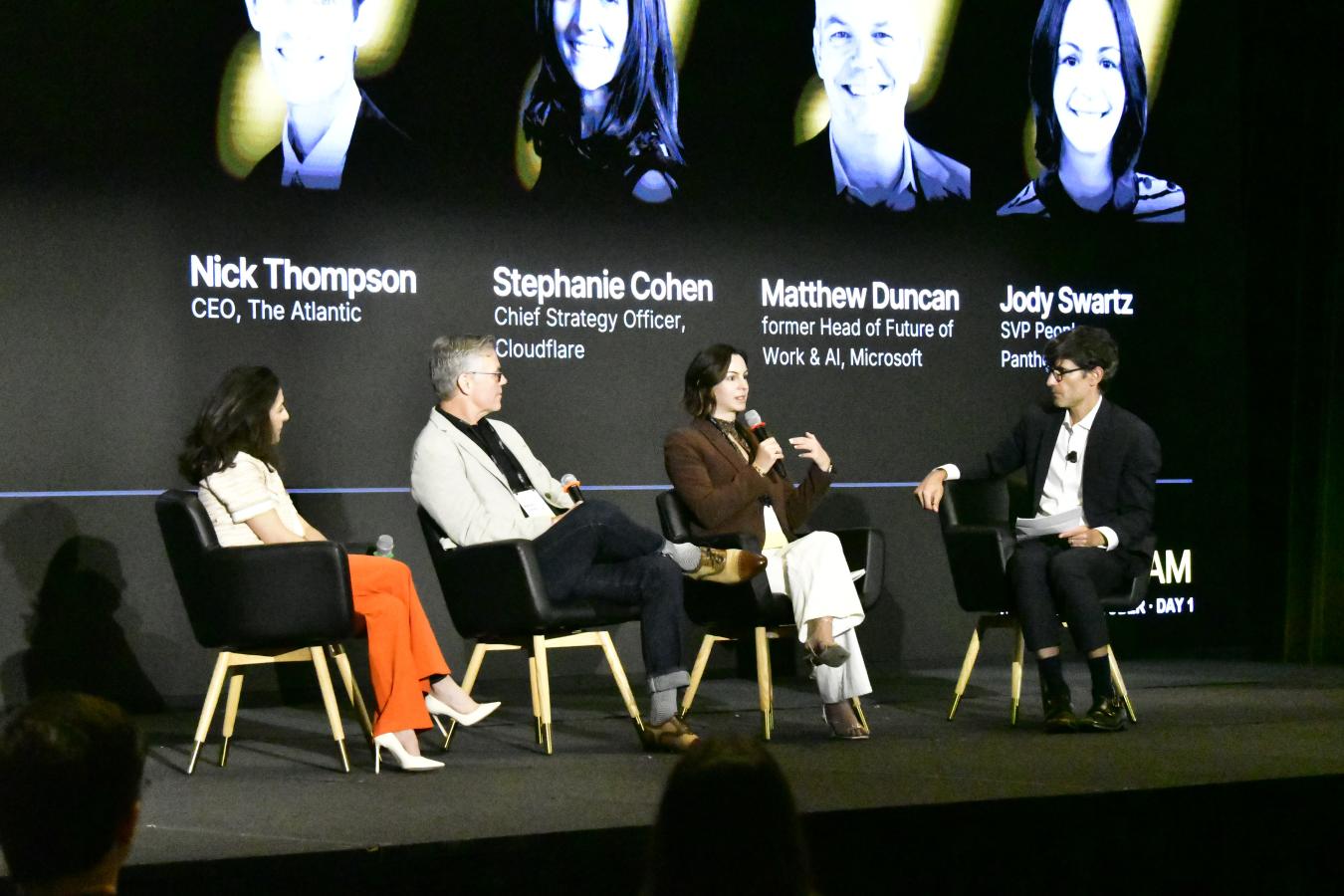
At /GoLive, Pantheon’s inaugural conference, I joined a panel on The New Age of the Web, alongside Stephanie Cohen, Chief Strategy Officer at Cloudflare, and Matthew Duncan, former Head of Future of Work and AI at Microsoft, moderated by Nicholas Thompson, CEO of The Atlantic. We looked at how AI agents are reshaping the web, and what that means for the companies and people who build it.
I brought the people lens to the conversation, focusing on what happens to work, to managers, and to judgment when AI takes on more of what we do every day. That put me in the hot seat for the question on everyone’s mind: Is AI going to take my job?
Nick put it to me in terms of hiring. If AI is changing this fast, how can we be certain humans will still be involved in the hiring process? Might it become entirely automated? My honest answer was yes, it’s plausible. Some companies will make that call.
But for people leaders, the real question isn’t how to stop AI from taking jobs. It’s choosing, intentionally, which decisions stay with humans, and ensuring your people are ready to make them.
As AI technology accelerates, more companies will have access to the same models and tools. So why should a customer choose your organization over a competitor? My answer is that it increasingly comes down to how your people shape your product and customer experience. How they think, how they decide, how they treat customers, and how they know when something doesn’t look right. As I said on stage, “Trust and judgment and that relationship and personality are the moat of what makes you, you. I think people crave that.”
Here’s how leaders can make people a true differentiator in this new era.
Redesign work around what is uniquely human, not just productivity
AI should take more execution off people’s plates. It should not take away judgment, development, relationships, or accountability.
When AI joins a workflow or handles the first contact with a customer, people gain capacity to contribute where it matters most: in places where their sound judgment and taste will influence the customer outcome. That raises the bar for talent. The work we do changes, and so do the skills it takes to do it well.
So how do you design these new workflows? At Pantheon, one of our values is Customers First, which is why I believe work should be designed around customer outcomes. Start with the outcome and work backwards. What are we trying to solve for our customers? Then work with the people closest to the work and build the optimal workflow with them, rather than deciding for them. Map the tasks, the decisions, the handoffs, and the points where things break down. People should stay accountable for decisions that are high-stakes or hard to reverse, especially when they affect customers, employees, security, or the company’s reputation. “Human in the loop” has become a reassuring phrase. But a person clicking “Approve” on most of the AI-generated output only creates the appearance of control.
On the Pantheon People team, we did this by mapping the candidate and employee experience from their first contact with recruiting through onboarding. We asked a simple question: where does human connection really change the experience, and where is the work mostly coordination or repetition? That showed us where AI could help with scheduling, summaries, and first drafts, and where a recruiter or manager still needs to own the conversation, the judgment, and the relationship.
One decision we made was keeping the final hiring call with managers. As I shared on the panel, “We still want hiring managers to exercise their judgment and taste and know what’s best for the team.”
The manager becomes more important, not less
When Nick asked how you ensure people working with AI follow the right rules and don’t cut corners, my answer came back to leaders and managers. Managers have to “create the environment where people feel like they can raise their hand and question things.” If AI takes on more execution, including the routine work people used to learn through, then managers must deliberately develop the judgment that work used to teach. Someone has to decide when to trust the system, when to challenge it, and when to stop it. That skill doesn’t come on its own.
At our recent Lead Summit for a cohort of Pantheon managers, we focused on a simple principle: coach, don’t solve. Ask before answering. Slow down on the reality of a situation. Give the problem back to the employee.
Those behaviors matter even more when AI can produce an answer instantly. The goal is not just a faster answer. It’s a stronger person and a better decision. Human judgment becomes the real advantage when there isn’t one obvious answer, when context, taste, and tradeoffs matter. As I put it on stage, AI is “really good at surfacing a lot of options, but it’s not always good at knowing what’s right for the given situation.”
AI changes the job, not just the toolset
It isn’t enough to tell people to use AI. As I said on the panel, a lot of organizations took the approach of “Okay, go use AI, go!” and were met with “Okay, but what do I do?” Leaders need to work with their teams to make the why, and the work itself, clear.
Start by naming where AI has changed the actual job. This matters more because of where the bottleneck has moved. Our 2026 State of the Web report surveyed 1,000 marketing, engineering, and IT and security leaders across the U.S., U.K., and DACH. It found that AI has made it faster to create content, code, and policy, but validation has become the shared bottleneck across all three functions. Roughly four in five leaders in every group, including 78% of engineering leaders, say manual validation is getting in the way of scaling AI. AI can produce an answer faster than an organization can determine whether it’s right. Engineers aren’t only writing code anymore. They’re also reviewing and fixing AI-generated code and building controls to make AI coding safe. That’s three different kinds of work, each with different skills and development needs, and much of it is new to the role.
Leaders should make that new work visible and clarify what AI owns, what the person owns, and what good performance looks like now. They also need to ensure employees still have meaningful ways to learn, such as reviewing work and taking on more responsibility over time.
The manager’s role is to turn changing expectations into development, giving people chances to practice the new work and recognizing sound judgment, not just speed or output.
Faster change needs more change management, not less
AI is helping us make decisions faster and rethink how work gets done. That doesn’t eliminate the need for change management. It increases it.
When people don’t understand why a change is happening, what it means for them, or who is accountable, they fill in the gaps, usually with the worst-case scenario. The durable advantage is to bring people along and embrace the change as the work evolves.
Where to start encouraging AI adoption
Pick one piece of work your team does every week. Ask the people doing it what’s frustrating, repetitive, or getting in the way. Then redesign it together.
Ask what AI should take off their plates, what people still need to own, and what they might lose if you automate too much. Spell out who makes each decision and who is accountable. And pay attention to whether people feel more capable and more enabled to do meaningful work.
In 90 days, success shouldn’t just be hours saved. It should be stronger judgment and people who feel more confident about how they contribute.
The technology will keep getting better and more widely available. What it won’t do on its own is build the judgment, trust, and culture that make an organization worth doing business with. That moat is still built by leaders, and it may be the most important work we have.
Explore the full findings in Pantheon’s State of the Web report.