
Unlock Agentic AI: Introducing the Content Publisher MCP Server for Next-Gen Content Operations
When we launched the Content Publisher public preview last fall, we focused on creating a "direct flight" for human users—eliminating the middle steps between content creation and its delivery on the website. While this was tremendous progress, it overlooked a new, significant user group: bots. AI agents are now integral to the workflow. The conversation has expanded from just focusing on where we (humans) work to equally considering where they (AI agents) operate.
Introducing the Content Publisher MCP server!

This release covers a broad range of capabilities, truly exposing the full breadth of Content Publisher to agentic applications. Users can now implement their workflows without limitations. AI assistants will take on diverse content production tasks, including:
- Day-to-day content management
- Strategic content operations orchestration
- Accelerating content marketing or newsroom initiatives
- Simplifying content migrations
- Speeding up localization
What is MCP?
Anthropic introduced Model Context Protocol, or MCP, in November 2024 as "a standard for connecting AI assistants to the systems where data lives, including content repositories, business tools, and development environments."
The goal? Solve an obvious challenge facing AI adoption. On one hand, LLMs and agentic applications were exploding at unprecedented speed. On the other hand, they struggled to deliver real-time impact because they worked in isolation, barely integrating with existing systems and data – and when they did, it required expensive custom development.
MCP promised to be the "USB-C" for connecting agentic applications with business systems, offering a standardized way for agents and assistants to work with enterprise tools through one unified protocol.
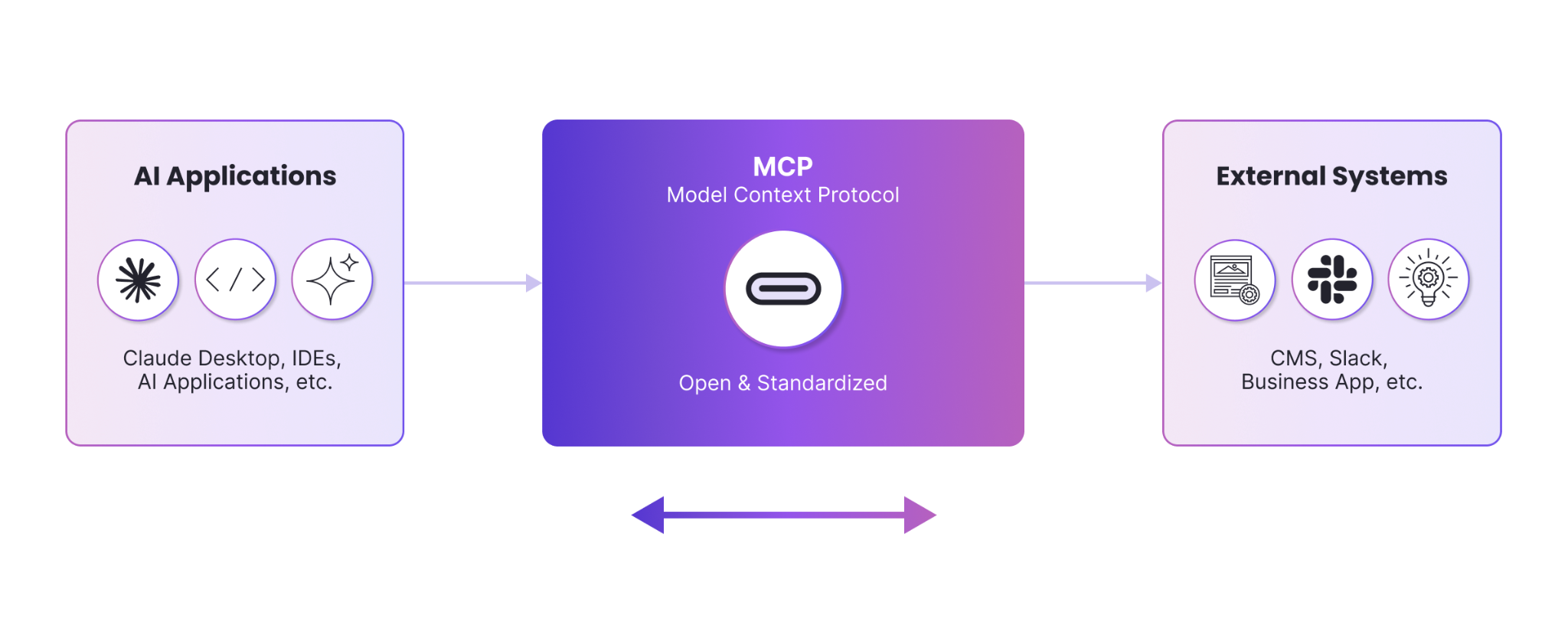
The promise was clear, and it led to rapid adoption. By October 2025, more than 10,000 public MCP servers were listed globally, with close to 100 million downloads of the official MCP SDKs (TypeScript and Python) by November. Anthropic even donated the project to the Linux Foundation to accelerate adoption further.
Now, thanks to MCP, applications of all types – from chatbots like ChatGPT or Claude, to software IDEs like VS Code or Cursor, to large enterprise agentic systems – can seamlessly access a broad range of business systems without any custom connectivity code.
In short, MCP went from experimental project to critical AI infrastructure in just one year, solving one of AI's biggest challenges: turning extraordinary capabilities into real, achievable value.
Why MCP Matters for Content Operations
AI has been helping generate content for years now. Whether text, images, video, or more, models are clearly transforming how we create content. Now AI is entering an adjacent area: how we operate and manage content workflows and operations at large.
Content operations involve many roles and many systems. The bigger the organization, the more complex the workflows, the harder they are to govern and orchestrate. The potential for AI to make substantial improvements is enormous. We see two major opportunities:
- Individual productivity gain. People are spending more and more of their work time in Claude, Gemini, and others. Like it or not, that's the new desktop. Giving users the ability to interact directly with their content operations where they already are—without context switching—is an immediate win. When content managers can get their jobs done by asking questions in natural language, directly from their agentic desktop, they'll jump at the chance. Think small tasks like updating terms or fact-checking, to more complex endeavors like ideating content with your AI assistant and seeing how it fits your web presence.
- Workflow automation opportunity. Complex workflows aren't just about individuals and where they work – they're about sophisticated automated systems. These will increasingly be implemented as agentic workflows, handling everything from content ideation to distribution. Tomorrow, if your content publishing is disconnected from these agentic workflows, your website becomes a major handicap compared to competitors. MCP prevents this. It's not just developer tooling—it's a critical business asset.
Agents can fact-check, maintain content, verify governance rules, check accessibility requirements, trigger workflows, suggest actionable improvements humans might miss, and accelerate everything in between.
That's why facilitating their work becomes critical—even as we keep "humans in the loop" and, more importantly, "humans in control."
What's Coming Next
We're releasing our MCP server in beta for early adopters who are using Content Publisher. It's here, it's available, and as a matter of fact, if you're reading this blog post, it means it's working because my buddy Claude posted this for me.
The MCP server is a critical component of Content Publisher, as vital as the open APIs on both the content ingestion and delivery sides. It equips users to manage Content Publisher via the AI assistants they’re already working with today, and brings complex agentic workflow applications to life across your content and web infrastructure.
Ready to see the Content Publisher MCP Server in action? Join our February Platform Tour webinar for a deep dive into the technology and what it means for your content workflows.