Tompkins Cortland Community College: From Research to Web Launch in 10 months
Image

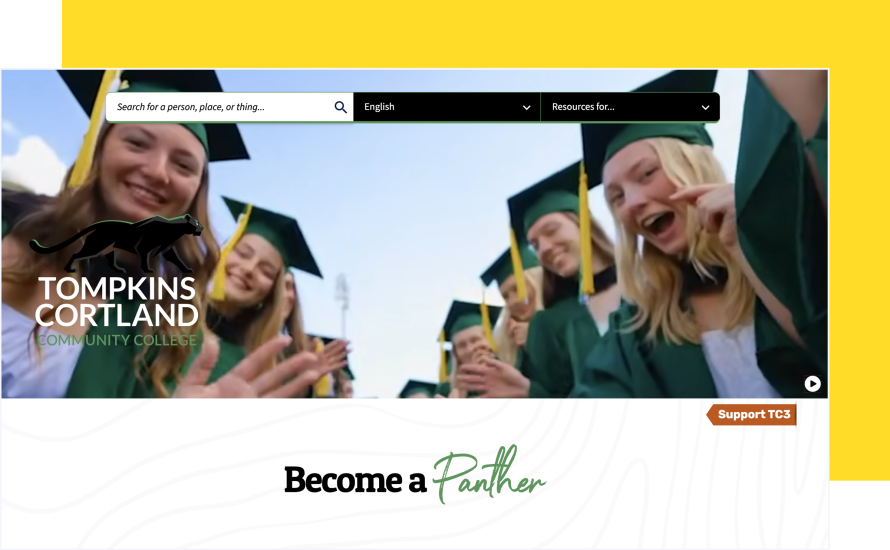
Tompkins Cortland Community College, a small college in rural New York, runs three Drupal websites on Pantheon – a public site for prospective students, an internal student hub, and an employee intranet – developed and maintained in partnership with the digital agency Northern.
The student site and the employee intranet are recent additions to the digital family. The transformation began with a public-facing website that “had wallowed for years without anyone to really own it.” That’s how Stephen Erwin, UI/UX Designer and Web Lead at TC3, described his first impressions when he took the job. He had one mandate: fix it.
What followed was a complete rebuild, a cybersecurity incident, and an accessibility overhaul – all managed by a team of four, with two key partners doing the heavy lifting alongside them.
Image
3,100 Pages and No One at the Wheel
The old TC3 website had roughly 3,100 pages, no real ownership, and editing rights distributed across campus with no oversight. Navigation changed unpredictably from page to page. Templates were rigid. The information architecture, as Erwin puts it, was "a confusing mess."
The site also lacked a web application firewall – a vulnerability that will soon be tested. On top of that, with increasing accessibility obligations, a comprehensive audit was in order. Inaccessible PDFs from staff across campus continued to pile up with no clear solution in sight.
Starting From Scratch, Strategically
For hosting, TC3 was already on Pantheon. When it came time to evaluate options, Pantheon won on both cost and fit for a small institution.
Fran Wyllie, Northern's Development Manager on the TC3 account, puts it plainly: "At least once a year with a legacy provider, we were doing manual Solr server updates, generating new SSL certificates, uploading them, hoping the site didn't break. On Pantheon, when was the last time we thought about updating an SSL certificate? Not since we've been on Pantheon. We don't have to think about that anymore."
Building for Self-Sufficiency
Working together, Erwin and Wyllie rebuilt TC3's web presence from scratch: full content audit, new information architecture, original designs, and a 10-month launch timeline. They went live in January 2025 with around 500 pages — down from 3,100 on the old site — organized to do more with less. The site has since grown to roughly 750 pages.
Erwin's approach was to build flexible content systems so TC3 could make changes without going back to code — a transfer agreements tool, for example, that lets students filter by intended major or target four-year institution, surfacing articulation agreements and credit mappings in a single interface. New features get prototyped in dedicated Pantheon multidev environments, letting Erwin test and give feedback before anything touches the live site.
Erwin is deliberate about how TC3 spends its agency budget: "I’d rather pay the agency to build me tools so that I can use those tools moving forward. Rather than needing to pay them for every change I want to make."
TC3 now handles about 90% of publishing and updates in-house, with Northern retainer hours used to expand capability, not manage routine tasks.
A Security Incident That Proved the Model
In October 2024, malicious bots drove traffic from around 400,000 transactions per minute to 11 million — a 2,650% spike. Pages loaded intermittently or not at all. Northern responded immediately, manually blocking attack vectors while Pantheon moved quickly to stand up a WAF. It was up and running in roughly two days.
"Pantheon stayed closely involved for two weeks after the incident, monitoring the site until the manual scaffolding Northern had erected could safely come down. The turnaround on all of that was kind of tremendous," Erwin says.
The incident got resolved in about a week. Adding Pantheon's WAF turned an emergency into a long-term security upgrade — one that has run quietly in the background ever since.
Accessibility: Divide, Conquer, Comply
Erwin and Wyllie divide the work by access: template-level issues go to the agency’s team; content-layer issues stay with the College. Shared access to DubBot keeps both sides aligned. For the persistent PDF problem, TC3 recently signed with DocAccess, a tool that intercepts PDFs on the Drupal site and serves them through an accessible viewer, potentially solving compliance at scale without policing every file individually.
One Year In: What It Looks Like When It Works
TC3 launched its new website in January 2025. For Erwin, the measure of success is almost philosophical: "The ideal web host is one where they fade away, and I don't even think about it, because it's just working." By that standard, TC3 is in a very different place than it was a year ago.
More Case Studies
Helpful resources to help your team succeed