
Escape the Website Relaunch with Elasticsearch for WordPress and Solr 9 for Drupal
We are doubling down on search. Elasticsearch is now generally available to WordPress sites. Solr 9 is generally available for Drupal sites. Both deliver essential search functionality that the WordPress and Drupal communities have come to depend on–facets, fuzzy matching, smarter relevance–and both open the door to AI integrations that can greatly level up how a site operates.
With that power, I expect many teams will find themselves, yet again, escaping the dreaded website relaunch. Sites still running Solr 8 (or legacy Solr 3) can upgrade today using the latest version of our Search API Pantheon module.
Please note: Solr 3 and Solr 8 are scheduled for removal next year. If you’re on either, this is your time to upgrade.
So, why does Pantheon now have two search backends doing roughly the same job?
Two backends, one philosophy
Pantheon added Solr back in 2012, and Elasticsearch for WordPress has been a top request for nearly as long. Our earlier attempts to combine Solr with WordPress were no match for the WordPress communities' strong affinity for Elasticsearch, anchored by the renowned ElasticPress plugin. So we shipped two: Solr for Drupal, and Elasticsearch for WordPress. While we aim to standardize and simplify your website operations, we also value where teams already are. For something as core to a site as search, what your teams actually want always wins.
Elasticsearch for WordPress
Here is a glimpse of what WordPress sites can do with Elasticsearch.
While there are many search-specific features that I love seeing, like facets, handling of typos with fuzzy matching, and relevance ranking, I find myself going back to WP_Query offloading. Too many WordPress sites suffer from slow queries against the canonical database, degrading the experience for site visitors. With ElasticPress, you can register queries to offload to the faster and more scalable Elasticsearch backend. ElasticPress can speed up your home page, not just the search result page.
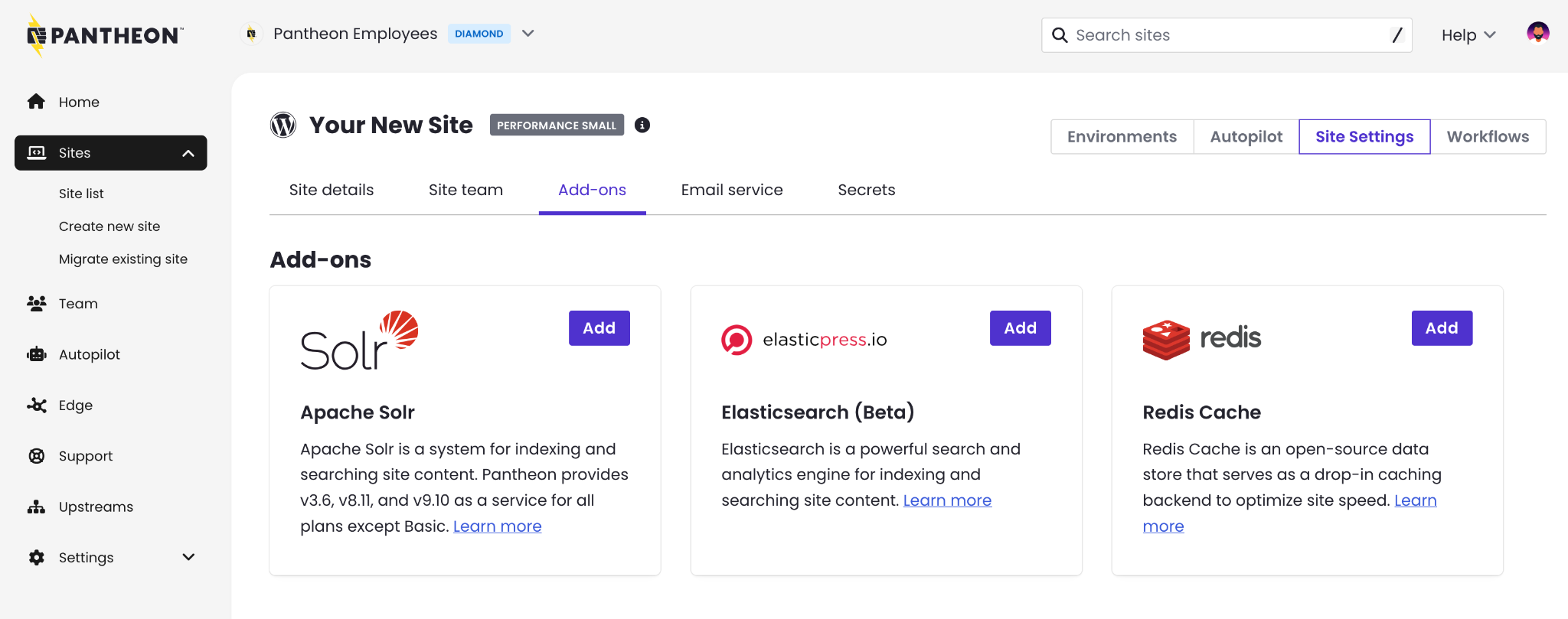
To try this out on Pantheon today, any site on a Performance plan or higher can enable Elasticsearch and add the ElasticPress plugin. See our documentation for more details.
If you’re as excited about the AI integrations as we are, dig into the ElasticPress documentation and come tell us what you're building in our Community Slack channel.
Solr 9 for Drupal
On the Drupal side, we have added a newer version of Solr and have scheduled the removal of Solr 3 and 8 for next year. The version bump is good news on its own. But the part I'm excited by is dense vector search. With a module like Search API Solr Dense Vector Field, you can combine an embedding model for meaning-based matching and a generative LLM that can write answers in RAG-style interfaces.

Once your content runs through the embedding model and gets indexed as vectors, Solr can match queries on meaning, not just keywords. "Electric vehicles" and "cars" mean nearly the same thing — but without dense vectors, a search for "cars" might miss every article you've written about EVs.
With a little bit of configuration, your site's existing Solr search interface can leverage AI without having to redesign, rebuild, and relaunch everything.
To upgrade, update to the latest Search API Pantheon module and follow these additional instructions. We've been wiring Solr 9 up to AI models inside Pantheon and having more fun than we probably should admit — looking forward to seeing what you build.
Searching for the bigger picture
Beyond search itself, here's why the Elasticsearch for WordPress and Solr 9 for Drupal releases matter: I think a lot of teams are going to use them to dodge another website relaunch. Stick with me.
The whirlwinds of AI have put the future of any website feature into question. Do we still even need a search feature within a website if AI changes everything? Do we still need websites at all? (If your concerns are that existential, pour a coffee and read some "AI Realism" from Pantheon co-founder Josh Koenig.)
Sticking just to search: any web team could reasonably wonder whether to refine their existing search or rip it out for a shiny 3rd party AI tool. And if you go for something new, which one do you pick? Is there room in the budget for it? Will that new AI tool live up to the hype?
For most teams, the better, safer, faster play is to bring AI to the search they already have — not to start from scratch.
For years at Pantheon, we have decried the all-too-common approach to major web projects:
- Declare the current website old and busted.
- Decide that the only sensible move is to redesign, rebuild, and relaunch.
- Dedicate months or years to the new thing, while you…
- Deprive the "old," but still live, public site of developer attention.
That was the norm when Drupal teams marched from Drupal 5 to 6, then 7 to 8. But the decade of architectural continuity since Drupal 8 has changed the math. Teams can keep improving the site they already have instead of bulldozing it every few years—and search is exactly the kind of feature that benefits from that stability. Refine it once, evolve it as Drupal evolves, and now layer AI on top without starting over.
Reaching potential without starting over
AI expectations are sky-high right now. Sorting out hype from reality and practicality isn't easy. Our hope is that the combination of a solid platform like Pantheon and the search backends each community already trusts lets more teams evolve their sites quickly and safely, instead of disappearing into a years-long rebuild. Iterating on the site you already have, in production, in front of real users, is almost always the smarter play.