Beyond the Technology: How LACMA and Urban Insight Share the Release
Image
Choosing the right technology is important, but how teams work together is just as critical. Even the best technical architecture can create challenges when responsibilities aren't clear and teams aren't aligned.
At Urban Insight, we help organizations align technology, teams, and release practices around complex digital experiences. Our work with the Los Angeles County Museum of Art (LACMA) brought together Drupal work deployed to Pantheon, AWS infrastructure, third-party systems, and multiple digital experiences. Each system served a specific purpose, but making changes across them required close coordination between LACMA, Urban Insight, and our technology partners.
Shared commit access became useful because it made one question visible: how would the client, agency, and platform share responsibility for review, release, recovery, and learning?
Technology Is Only Part of the Equation
Teams choose different frameworks for good reasons. Drupal can support structured content and complex editorial workflows; Next.js can support a different frontend experience; cloud infrastructure and third-party services can solve specialized problems. Making these technologies work together requires more than good architecture. It also requires clear responsibilities, communication, and a shared approach to managing changes.
LACMA’s collections project made the need visible. Specialized collection data, multiple systems, and different delivery experiences required clear ownership, a defined path between systems, and a tested recovery plan.
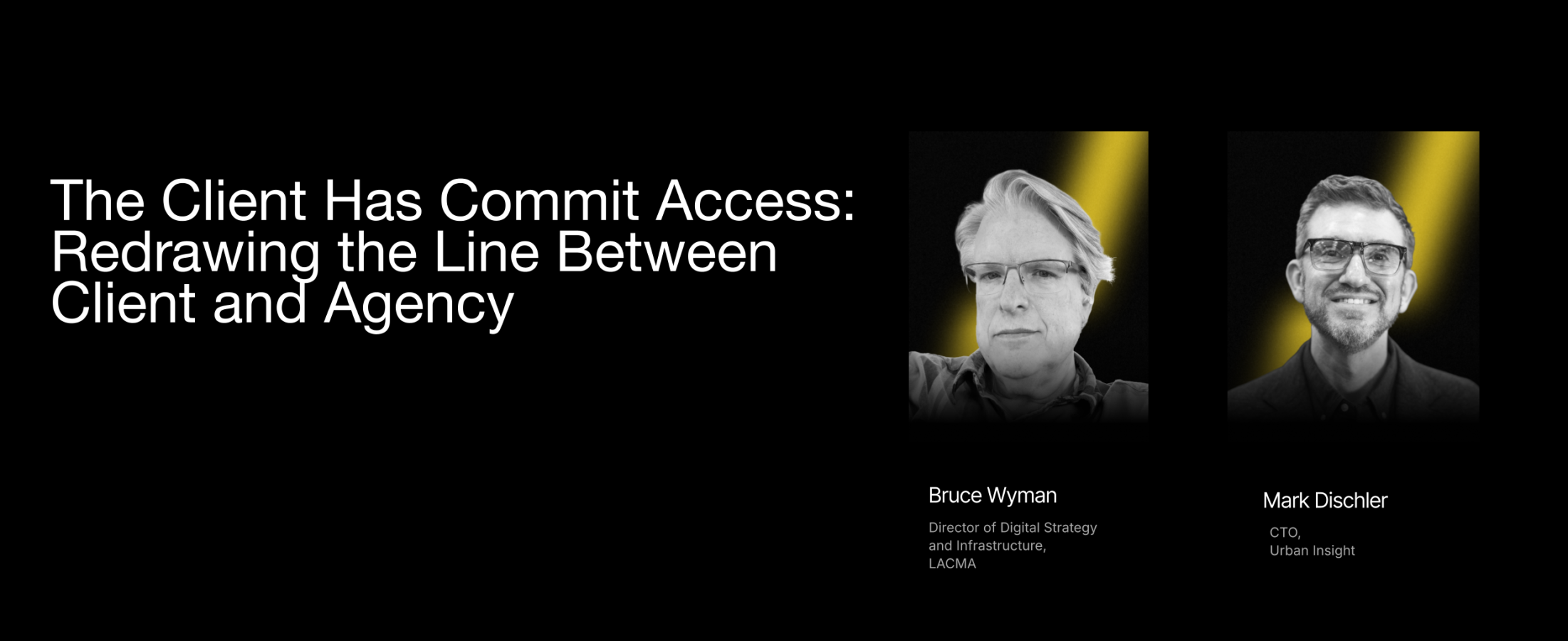
Bruce Wyman, Director of Digital Strategy and Infrastructure at LACMA, described the relationship in a way that captures the operating-model challenge:
“There's no clear line ever. It's a very malleable relationship, with each side leading different parts of the work at different times.”
That flexibility has been one of the strengths of our partnership. Rather than drawing rigid boundaries around who does what, we've built a relationship where each team can take the lead based on its expertise, while maintaining clear communication and accountability.
Shared Access, Shared Ownership
When Wyman joined LACMA, the organization was dealing with aging infrastructure, technical debt, and a web estate that had settled into maintenance mode. Our first conversations were direct. LACMA wanted visibility into the work, and Urban Insight needed to understand the museum’s goals, priorities, and operating realities.
That led to greater transparency, closer communication, and a model in which Wyman could contribute to Drupal projects and modules. Over time, LACMA contributed five or six Drupal modules to Urban Insight’s repository.
The relationship also changed how we handled work. Wyman could take on problems that depended on his knowledge of LACMA’s data, content, or internal priorities. Urban Insight could focus on the architecture, implementation, and integration work where our experience added the most value.
What makes this relationship work isn't simply that Wyman has access to our codebase. It's that we've developed a level of trust where we can challenge each other's ideas, share responsibility for decisions, and take advantage of each team's strengths. That kind of collaboration requires openness on both sides, but the result is a much stronger partnership.
Supporting Collaboration with Pantheon
For the Drupal work, Pantheon gave us the managed infrastructure and environments to support collaboration. We could work in Multidev environments, move changes through development and test, and quickly roll back changes when needed.
That discipline mattered when a deployment involving Wyman’s module surfaced an issue after review and testing. The team moved quickly to restore a working state and then investigated the cause together.
The follow-up traced the issue to deployed scripts that had not run as expected after the module was merged. We improved the review process and clarified ownership. Pantheon provided the Drupal release mechanics; the teams coordinated the work across LACMA’s broader digital estate.
Four Months to Relaunch
LACMA’s online collections project put the model under pressure. The team had roughly four months to relaunch the experience. Wyman described a collection of around 120,000 objects, including 68,000 with images and alternate views. The work was completed in three and a half months, followed by additional remediation.
That pace required a deliberate division of labor. LACMA owned the museum-specific data decisions and how the collection should be understood and presented. Urban Insight took responsibility for frontend and integration work. Pantheon supported the Drupal portion of the release path, while other systems remained in their respective environments.
The teams also kept communication close. Urban Insight gave Wyman access to an internal Slack channel so he could reach the people working on the project directly. He used that access to surface implications quickly, especially when a decision in one part of the system could affect another.
Our goal wasn't to standardize every system or process. It was to make sure the teams could work efficiently across different technologies, with the right people involved at the right time. Watch the whole story:
Building on Trust and Shared Responsibility
Successful projects depend on more than technology and well-defined processes. They require a shared understanding of goals, clear responsibilities, and a willingness to work together when challenges arise. That's what we've built with LACMA, and it's what allows our teams to be proactive rather than simply responding to problems.
It really is a peerage, though, because we need you to understand what we want to do and why we want to do it, because at some point the most important thing you can do for us is to be proactive rather than reactive.”
- Bruce Wyman, Director of Digital Strategy and Infrastructure at LACMA
Shared commit access gives the people closest to the work a place in the release process, while clear responsibility keeps the process safe and repeatable. Technologies will continue to evolve, but the foundation of a successful partnership remains the same: trust, transparency, and shared responsibility. Those are the things that allow teams to move quickly, solve problems together, and deliver better results.
Keep on reading
A Great Museum Relaunch for The Broad
Japanese American National Museum’s Multilingual and Design Transformation on Drupal