How A to Z Sports Builds Fan Experiences at Speed on WordPress
Image

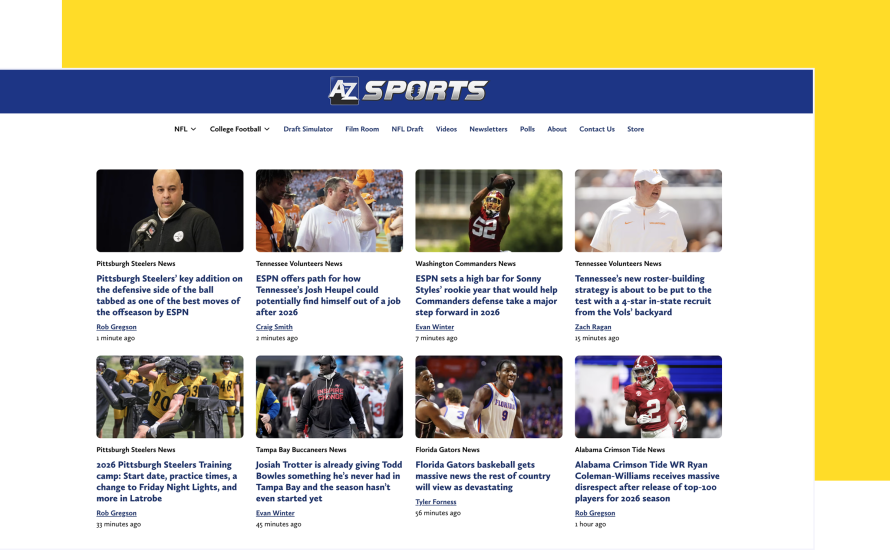
A to Z Sports covers 32 NFL teams and college football for a community of more than 4 million social media followers, 200,000+ newsletter subscribers, and an audience that generated over 100 million page views in the last two years. The business runs on four pillars – website, social, newsletter, and video, all ad-supported, with ambitions to build fan experiences.
That ambition required infrastructure to match. To build what he had in mind, CEO Zach Bingham needed to own his platform outright and move on his own terms. "We decided to take back our own independence," he says. "Google, Meta, big tech, they control a lot of this world, and really our industry. We needed to be nimble with our decision-making."
Image
The urgency behind that independence has only grown with the rise of AI search. As LLMs absorb and summarize sports content, the question facing every publisher is: why would a fan click through at all? Bingham answers that A to Z Sports offers something AI can't.
"AI cannot tell you why that interception in the third quarter – with 3 minutes and 14 seconds left – happened, and how it impacted the divisional standings, which then impacts the playoff race," he says. "That's the context we give with our creators and our voice. We try to spread our content in all different ways that AI just can't resurface, scrape and steal." Building interactive experiences – simulators, predictors, trivia – is part of the same strategy: give fans a reason to show up, not just a reason to search.
Behind that output is an editorial team of 20+ writers covering every NFL franchise, all running through a publishing process that Bingham knew had to get faster. "The number one thing I had to do was expedite the efficiency of our human process – how to publish, how to edit, how to send newsletters," he says.
Fueled, Pantheon’s partner and the agency that had previously worked alongside A to Z Sports on their platform infrastructure, was the natural choice for the next chapter.
Solution: A WordPress Rebuild, Smarter Search, and a Simulator Built in Weeks
Choosing WordPress Over Headless
Fueled evaluated whether to carry over a headless architecture but concluded it wasn't the right fit. "If mostly what you're doing is showing an article to a user, headless is most of the time overkill," explains Tyler Cherpak, Director of Engineering at Fueled. "Whenever you deploy a change on WordPress, you also have to deploy something on the React side so the two things know what they're talking about. That's a lot of extra overhead." A standard WordPress build on Pantheon gave A to Z Sports full editorial control, without the engineering complexity, and the freedom to move fast when it mattered.
The launch was timed deliberately: April 1st, with just enough off-season runway to stress-test the platform before NFL Draft traffic kicked in.
ElasticPress: Search That Actually Tells You Something
One of the standout features of the new build is Pantheon's Elasticsearch integration. Within weeks of launch, AtoZSports.com had processed 12,000 search queries at approximately one query per second. This was a clear signal that fans are actively hunting for specific content, not just browsing.
Fueled, ElasticPress’s plugin founders, implemented their search stack, including custom result weighting and the ability to add filters by team or player. Beyond the user experience, the real opportunity is editorial intelligence: every search query is a data point. If fans are searching "Lions wide receiver depth chart" hundreds of times a day, that's a content brief — and a direct line from audience behavior to the editorial calendar.
The Draft Simulator: What Happens When a Sports Editor Gets AI Superpowers
The most striking chapter of the build happened in parallel with the main migration. In March 2026 – just weeks before the NFL Draft – Travis May, A to Z Sports' in-house College Football Managing Editor, built a fully interactive NFL Mock Draft Simulator from scratch using AI coding tools. Conceived and shipped in under a month, the simulator lets fans step into the draft room, pick players, field trade offers and receive a grade on their selections.
What would have previously required an outsourced development contract and months of lead time was built in-house, at speed, by someone whose primary role is content, not code. Fueled helped get it live on Pantheon, placing ads, fixing the layout, and walking the team through the Dev, Test, Live deployment process. "It was working when it came to us," recalls Cherpak. "We just helped them get it where it needed to go."
The results validated the approach immediately: 350,000 page views in the first month, with sessions averaging 6 to 10 minutes per user. "We leveraged our audience on AtoZSports.com and our community to drive traffic there," says Bingham. "It was successful, and now we want to build more."
The simulator is now a blueprint for what comes next: a trade simulator, playoff predictor, depth chart integrations and sports trivia – a full fan engagement layer built alongside
editorial content, largely in-house, powered by AI tools. "That opened our eyes to so many great things we can build and put in front of our audience," says Bingham.
Since launching on Pantheon, A to Z Sports has the infrastructure and the independence to operate as both a media company and a product company. "I went from a sports broadcaster to a tech owner very fast," says Bingham. "Two years ago, we were just concentrating on writing articles. Now we're producing videos, writing articles, sending newsletters, and creating experiences like our simulator."
With the platform stable, the next priority is editorial throughput. Content Publisher, Pantheon's streamlined content workflow tool, is in onboarding now, with the goal of giving writers direct, simplified access to publish without bottlenecking the team.
More Case Studies
Helpful resources to help your team succeed